1907: Rudyard Kipling
Showing posts with label 1907: Rudyard Kipling. Show all posts

The Man Who Would be King (1888), and other stories by Rudyard Kipling


Have I read Kipling before?  I'm sure I did as a child.  Perhaps The Jungle Book, or Puck of Pook's Hill or the Just-So Stories.  Maybe someone read them to me when I had my eye operation in 1959 and wasn't allowed to read for six months. (What purgatory!)

My mother could recite If (1895) by heart, and quoted it often to her three daughters.

If you can keep your head when all about you
Are losing theirs and blaming it on you;
If you can trust yourself when all men doubt you,
But make allowance for their doubting too;
If you can wait and not be tired by waiting,
Or, being lied about, don't deal in lies,
Or, being hated, don't give way to hating,
And yet don't look too good, nor talk too wise;

If you can dream - and not make dreams your master;
If you can think - and not make thoughts your aim;
If you can meet with triumph and disaster
And treat those two imposters just the same;
If you can bear to hear the truth you've spoken
Twisted by knaves to make a trap for fools,
Or watch the things you gave your life to broken,
And stoop and build 'em up with wornout tools;

If you can make one heap of all your winnings
And risk it on one turn of pitch-and-toss,
And lose, and start again at your beginnings
And never breath a word about your loss;
If you can force your heart and nerve and sinew
To serve your turn long after they are gone,
And so hold on when there is nothing in you
Except the Will which says to them: "Hold on";

If you can talk with crowds and keep your virtue,
Or walk with kings - nor lose the common touch;
If neither foes nor loving friends can hurt you;
If all men count with you, but none too much;
If you can fill the unforgiving minute
With sixty seconds' worth of distance run -
Yours is the Earth and everything that's in it,
And - which is more - you'll be a Man my son!

Anyway, what I remember of Rudyard Kipling (1965-1936) is Mowgli and the exotic settings in India, and the tragic story of his only son John being killed in the trenches on his first day - after his father had wangled a commission for him despite John's poor eyesight.   The great writer so closely associated with British imperialism was never the same after that.

The Man Who Would Be King is nowadays a term signifying grandiose ambition, but it comes from this short story of an ordinary man over-reaching himself.  Daniel Dravot is an opportunistic rogue who slips away from the British Raj into the wilds of Afghanistan with his mate Peachey Carnehan.  There they set in place their absurd ambition to be kings and with guile and cunning convince the tribesmen of Kafiristan that they are gods.  The ruse succeeds until Dravot goes too far, and the girl he demands for his pleasure sees through him, not unlike the child who denounces the Emperor who has no clothes. When, in fear of a being she believes to be a god, she bites Dravot and draws blood the game is up.  He dies a gruesome death when the Kafirs cut the ropes of a rope bridge on which he is standing, while Peachey is crucified.  When he is still alive after twenty-four hours, the natives think it is a miracle, and set him free.  When he meets up again with the world-weary narrator he is carrying in his bag Dravot's shrivelled head, complete with crown. He has lost his wits, able only to give a garbled account of events before wandering away, dying shortly thereafter from sunstroke.

The real villain of the story, it seems to me, is the weather which drives men mad.  Kipling recreates the misery of the monsoon and its enervating heat as only the yet-to-be-acclimatised can:

It was a pitchy black night, as stifling as a June night can be, and the loo, the red-hot wind from the westward, was booming among the tinder-dry trees and pretending the rain was on its heels.  Now and again a spot of almost boiling water would fall on the dust with the flop of a frog, but all our weary world knew that was only pretence. (p120, Wordwoth Classics Edition, 1994)

I wasn't planning to read the rest of the stories because the TBR was overwhelming everything else on the bedside table (that's the bedside TBR, a pale imitation of the real TBR in the Library which now stretches to seven shelves) - but the title of Baa Baa Black Sheep in a collection of stories for adults piqued my interest.  It's the story of 'Punch' and Judy, sent from the warm embrace of Mumma and the Ayah to cold and cheerless England and the not-so-loving care of Aunty Rosa and her hideously unforgiving religion.  While Uncle Harry is alive there is some solace, but once he is gone there is only endless spite and cruelty.  Rosa's boy Harry bullies Punch mercilessly, carries tales home from school, incites other boys to beat him and manufactures lies for which Punch gets the blame.  The punishments are so extreme that the boy partially loses his sight, a condition exacerbated by reading to escape his misery.

The story is told from the boy's point of view, charting his blithe optimism and descent into pessimistic misery.  Mumma eventually returns from Bombay and there is restitution and recovery, but the damage is done:

For when young lips have drunk deep of the bitter waters of Hate, Suspicion, and Despair, all the Love in the world will not wholly take away that knowledge. (p115)

Prescient words in 1888 when very little was known about the effects of abuse on young minds.

Wee Willie Winkie was another title that intrigued me.  It's also told through the eyes of a child but from a very different perspective.  It's about a kind of heroic child beloved by didacts of imperial persuasion in the 19th and early 20th centuries.

The child nicknamed Wee Willie Winkie is the precocious son of the Colonel in charge of the 195th Regiment - and he's been brought up with military discipline.  When he's naughty his 'good conduct badge' is removed and on the occasion of his accidental firing of a week's hayfeed, the punishment is extended to include being confined to barracks (the house and verandah).

But when the little fellow sees Miss Allardyce, the beloved of his hero Coppy the subaltern, riding off (for reasons not explained) across the river and out of the safety of the cantonment, he breaks his 'arrest' to rescue her and bring her back - for he knows there are Bad Goblins there.  He is too little to know that the Goblins he's been warned about are lawless Pashtun Afghans, but he knows she is in peril.  When he catches up with her, she has sprained her ankle, and so he sets his pony off with a smack on its rump because he knows it will go home and the alarm will be raised.  And then the Pashtun arrive, with plans for kidnap and ransom (and worse, perhaps, unspoken).

The scene that follows betrays Kipling's imperial arrogance at its worst, and is barely credible.  The little boy, accustomed to ordering natives about, demands that they stop frightening the Miss Sahib and ride for help.  He does this capably because despite his childhood lisp he is fluent in three languages.  Instead of thrashing him and abducting her, they recognise that the boy (born to rule?) is precious to the regiment back in the cantonment and that there will be reprisals from the mighty British Raj if they harm him.  To complete their humiliation, the rescue party arrives in the nick of time and the Pashtun flee.

Now a 'pukka hero' Wee Willie Winkie rejects his nickname, and is henceforth known as Percival William Williams, thereby designating his manhood and his status as an 'officer and a gentleman'....

It's a good thing I didn't read this one first, or I might not have bothered with the others.

Author: Rudyard Kipling
Title: The Man Who Would Be King and Other Stories
Publisher: Wordsworth Classics, 1988
ISBN: 9781853262098, pbk., 224 pages
Source: Personal library

© Lisa Hill

Cross-posted at ANZ LitLovers where you can join in a conversation about the book if you want to.

Kim by Rudyard Kipling

Reviewed by Edith LaGraziana

A Boy and a Red Lama
on the Diamond Way

Worldwide most reading lists for children contain at least one book written by Rudyard Kipling (1865-1936) who was awarded the Nobel Prize in Literature 1907 “in consideration of the power of observation, originality of imagination, virility of ideas and remarkable talent for narration which characterize the creations of this world-famous author”. Without doubt The Jungle Book and The Second Jungle Book are the most popular and most widely read ones of his children’s books along with Just So Stories, but also his 1901 novel Kim uses to be classed with the classics of children’s literature although the author wrote it for adult readers really.

In fact, Kim is a gripping adventure and spy novel surrounding the orphaned Irishboy Kimball O'Hara who is thirteen years old when his story begins in the streets of Lahore, India. Rudyard Kipling set the boy’s almost savage existence against a colourful and vibrant backdrop of India around 1900 that includes many details of daily life, customs, society, politics and not least religion that children or less informed adults may not fully grasp nor be interested in. Even Kim only understands part of what is going on. He is too young and he never knew the life of a European Sahib, but grew up like any Indian boy in the poor neighbourhood. He never learnt to write nor to read. Moreover, he speaks the local languages better than English. Kim is a clever boy, though, with many friends and perfectly able to look after himself, when

“… there shuffled round the corner, from the roaring Motee Bazar, such a man as Kim, who thought he knew all castes, had never seen. He was nearly six feet high, dressed in fold upon fold of dingy stuff like horse-blanketing, and not one fold of it could Kim refer to any known trade or profession. At his belt hung a long open-work iron pencase and a wooden rosary such as holy men wear. On his head was a gigantic sort of tam-o'-shanter. His face was yellow and wrinkled, like that of Fook Shing, the Chinese bootmaker in the bazar. His eyes turned up at the corners and looked like little slits of onyx.”

As it turns out, the man is an old Red Lama from Tibet called Teshoo on a pilgrimage to find Buddha’s legendary “River of the Arrow” that frees from the “Wheel of Things”. Out of curiosity and because Kim feels that the old man will need help to get along in a country full of crooks, he joins him as his disciple. At the same time Kim thinks that wandering about with the lama will give him the opportunity to look out for the great Red Bull on a green field that – as his late father always told him – would come for him with the Colonel riding on his tall horse and nine hundred devils. To raise money for the travel Kim accepts to secretly take a letter to an Englishman in Umballa for his Punjabi friend, the horse-dealer Mahbub Ali, and thus first gets involved in espionage in colonial India where local powers still try to shake off British rule and regain sovereignty. Before long, both Teshoo Lama as well as a British officer in charge of recruiting spies see to it that Kim gets some formal education and he becomes a St Xavier's boy in Partibus at Lucknow for nearly three years. Then he resumes his wanderings with Teshoo Lama to be initiated as a spy afterwards, but he is pushed into the trade much sooner than expected…

All things considered, I enjoyed reading Kim very much. It’s true that from today’s point of view the novel must be called a children’s book rather than adult fiction, and yet, it offers such a vivid and detailed picture of Indian cultures and religions that it amazed me. In addition, it is a testimonial of Indian history from the point of view of an Englishman whose great intelligence and exceedingly sound education show through every line.

Nota bene:
Since Rudyard Kipling has been dead for a long time, thus it goes without saying that his works are in the public domain and can legally be downloaded for free from sites like Project Gutenberg and ManyBooks.net just for instance. An expertly made-up free edition of Kim is available on Feedbooks.


Original post on Lagraziana's Kalliopeion:

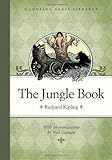
The Jungle Book by Rudyard Kipling

Hi everyone! I'm Athena of Aquatique and I'm back from hiatus! This was my first Nobel Laureate read of this year. I hope to update more in the future on this blog. Without further ado:

The Jungle Book


This edition of The Jungle Book includes an introduction from Neil Gaiman, and stories from both the first and second books. It features all the stories about Mowgli and one not with him.

I seemed to have missed out on reading this in my childhood. I got the feeling I started this when I was younger but never got around to finishing it. I still very much enjoy reading young adult and
children's books. I think I will keep reading them, and I hope to always find them enjoyable like I did this book.

I really liked all the characters in the Mowgli canon even Shere Khan the lame tiger. I do seem to appreciate stories about anthropomorphic characters though especially in young adult literature. Authors tend to imbue them with charm, innocence, but wisdom at the same time.

There were some good stories about life, death, and the nature of the world. It was sometimes sad as it can be with realistic stories. I think this is a good book about Man on earth and human's relations to the environment and animals. A book like this is always good to remind us of what our role on this planet should or could be.

I think this a good read for all ages, and I look forward to reading them again.

Kim by Rudyard Kipling (Lisa Hill, ANZ LitLovers)

I enjoyed this.  It's one of those classic books I always meant to read, part of my British heritage known around the world because of Kipling's influence on the scouting movement. 
Kim is a boy enlisted by chance to work for the British Secret Service in India. He is orphaned by a sick mother and a feckless Irish father in service in India, and he lives in the streets.  One day he is captured by the British, who find his ID papers in a scapula around his neck - and they send him off to school.  A certain Commander recognises his potential as an 'agent' because he is familiar with Indian street life and its languages.
Kim takes to the streets on a quest for enlightenment with a Buddhist Lama, but is able to serve His Majesty in various other ways as well, including acquiring precious papers implicating an Indian prince's conspiracy with Russians to the north.  One of his accomplishments in to quell an Indian uprising and in this he is aided by Muhtab, a Muslim, and Hareem, a Hindi - and nowhere is their quisling role questioned.  (I read a similar short story to this in which a British boy singlehandedly quells a riot, in The Man Who Would Be King, and no, it's not ironic.)
Kipling was an old colonialist, after all, and everything I've ever read by this author champions the British Raj and the Empire.  It's a fair bet that he'd never have got a Nobel Prize in these post-colonial days!

Rebecca's 2008 Progress

I've read five Nobel Prize authors, six books in 2008. I've posted a few here, but I've neglected to post the others on this site. Here are links to all of them if you're interested.
  • East of Eden by Steinbeck (I read this in March, before I began book blogging. Technically, I guess that doesn't count because it was before I "joined" Read the Nobels.)
  • Just So Stories by Rudyard Kipling (on Read the Nobels)
  • Life and Times of Michael K (on Read the Nobels)
  • Speeches of Winston Churchill (on Read the Nobels)
  • The Jungle Book and The Second Jungle Book by Kipling (on Rebecca Reads)
  • The Old Man and the Sea by Hemingway (on Rebecca Reads)
I don't think I'll be reading any more this year, but I have a number of them up in my reading line up for next year.

Just So Stories by Rudyard Kipling

I chose to read Rudyard Kipling’s Just So Stories first for the Read the Nobels challenge because I remembered the imaginative premise of his magical world and wanted to experience his world as an adult (and read it to my infant son). I very much enjoyed reading the stories again, although there are some “politically incorrect” stereotypes in them I hadn’t expected.

In these stories, Kipling gives us the fairy tales that explain to us how the things we are familiar with came to be: how the whale got his throat, how the elephant got his trunk, how the leopard got spots, and so forth. I enjoyed a retreat into a magical world. Reading Kipling’s stories encouraged made me to think of my own creative explanations for why things are as they are. Instead of taking our children literally, let’s give them stories that explain things! The creativity is fun. My favorite stories were “How the Camel Got His Hump” and “The Cat That Walked By Himself.” I liked all twelve.

Kipling wrote these stories for children. Each story is from the perspective of an adult talking to a child. They feel like folk tales—and they are all delightful and innocent creations of imagination.

I believe these stories appeal to children, even 100 years later. I have one concern, however: a few stories have some issues. Call the issues what you want: stereotypical, politically incorrect, insensitive, rude, racist, etc. For example, in telling the story of how the tides came to be (in “The Crab that Played with the Sea”), Kipling describes a man who is “lazy” and doesn’t want to row his boat; he begs the fisherman on the moon to put down his line and pull the sea so he won’t have to row. Kipling claims this man was the ancestor of the “Malazy” people. There are also similar stereotypical comments about women, men, and other racial groups, including the word “nigger”. None of the stereotypes or offensive words are integral to the stories and I don’t think a child will pick up on (some of) the references, but it certainly caught my attention. Such explanations are obviously as silly as how the elephant got his trunk, but they do make the stories seem dated. The copy I read was complete and unabridged; I imagine edited versions take out the offensive references.

Did you read these stories as a child, and did you notice the references that are insensitive? Have you read these stories as an adult? What do you think about the early-1900s stereotypes in the text? Should classics like these stories be left alone, or should editors “correct” or deftly delete the stereotypes to avoid offense, especially in books for children?

I originally wrote this here on my blog. I'd love for you to join in on the discussion on my blog.

Kim by Rudyard Kipling

Cross posted from my blog...

Title: Kim
Author: Rudyard Kipling
ISBN-13: 9780140183528

Publisher: Penguin Group/338pages
First Published: 1901
Kim is a story about a British orphan about thirteen years of age who has been raised on the streets of Lahore, now in Pakistan. He speaks fluent Hindi, understands assorted dialects and, is well versed in whirl of religions and cultures. He takes to the road as a disciple of a wandering Tibetan priest in search of a mythical holy river with healing powers. Along the way, he has a chance meeting with his deceased father's old army regiment and his identity is revealed to him. The army sends him to an English language Catholic school in the south, but his underlying value, because of his knowledge of local language and understanding of culture, is quickly made use by a member of the British secret service.

Kim is not a children’s book. A child may be the main character, but the book is too philosophical and filled with complex human behaviour to be of much interest to children. The main thrush of the book is the relationship between Kim and the Red Lama, the basic story of two people, one an orphan boy and the other an elderly mystic, finding many of the things they are seeking in caring for and looking after one another.

In Kim, Kipling characterizes all the good of India while playing down the contrasts. He shows us what India would have been like in an ideal situation of mutual tolerance. Kipling’s observations are remarkable and one realizes from time to time that it is not the writer’s imagination about a period long gone but that he was in fact a part of that period. The sights, sounds, phrases, references, and personalities are entirely authentic. Kipling captures the sound, smell, and colour of India in the early part of the 20th century like no one else. He was a writer gifted with an acute sense of observation and a keen eye for details.

Another angle on the story is what is says about modern human intelligence operations. The leading British intelligent agent recognizes that Kim has language and culture skills that cannot be taught in any academy.

The story takes place after the Indian mutiny of 1857when many families were divided by violence. That period was a time of immense upheaval in India. It went from being a country made up of many native princely states with Englishmen as merchants to one unified under the flag of England. There was tension between the English in India and the Indians. There was also a staunch love of India by those same ruling Englishmen and women. Even Kipling did not envisage that the mutiny of 1858 was a step in the fight for India's independence. He was convinced that what England was doing was right despite his love for India. There in lies the irony.

At places, one has to plod through despite the poetic language. Still this is well worth the read. It does give a good glimpse of British rule in India.
·
OLDER


© Read the NobelsMaira Gall