1982: Gabriel Garcia Marquez
Showing posts with label 1982: Gabriel Garcia Marquez. Show all posts

García Márquez, Gabriel "One Hundred Years of Solitude"

(Spanish: Cien años de soledad) - 1967

Reviewed by Marianne
from Let's Read


My first book by Gabriel García Márquez. Not my last. A saga of a family, one of those fantastic South American magic realism novels.

Seven generations are described in this tale, starting when the first member immigrates to Colombia, spanning almost a century of South American history during the colonial years. A lot of symbolism is used which makes this book even more interesting.

I have re-read this in the meantime. It was just as fantastic as the first time around. This author amazes me every time.

From the back cover:

"One of the 20th century's enduring works, 'One Hundred Years of Solitude' is a widely beloved and acclaimed novel known throughout the world, and the ultimate achievement in a Nobel Prize- winning career. The novel tells the story of the rise and fall of the mythical town of Macondo through the history of the Buendi a family. It is a rich and brilliant chronicle of life and death, and the tragicomedy of humankind. In the noble, ridiculous, beautiful, and tawdry story of the Buendi a family, one sees all of humanity, just as in the history, myths, growth, and decay of Macondo, one sees all of Latin America.

Love and lust, war and revolution, riches and poverty, youth and senility - the variety of life, the endlessness of death, the search for peace and truth - these universal themes dominate the novel. Whether he is describing an affair of passion or the voracity of capitalism and the corruption of government, Gabriel Garcia Marquez always writes with the simplicity, ease, and purity that are the mark of a master.

Alternately reverential and comical, '
One Hundred Years of Solitude' weaves the political, personal, and spiritual to bring a new consciousness to storytelling. Translated into dozens of languages, this stunning work is no less than an accounting of the history of the human race."

I also read "Love in the Time of Cholera" (with my book club) and loved it.

Gabriel García Márquez received the Nobel Prize for Literature in 1982 "for his novels and short stories, in which the fantastic and the realistic are combined in a richly composed world of imagination, reflecting a continent's life and conflicts".


Read my other reviews of the Nobel Prize winners for Literature.  

Original Post on "Let's Read".

Marquez, Gabriel Garcia "One Hundred Years of Solitude"


Goodness!

What a read. Or more accurately, a reread. I bought my Penguin edition of One Hundred Years of Solitude on the 3rd April 1996 in Sydney. At a guess, it must have been the Easter school holidays and I was visiting my sister, who lived in Coogee, for a few days. I cannot remember if I read it straight away, or waited until I went home. Either way, I have very little memory of reading this book, except that I found it challenging and often confusing. It was also funny and disturbing and completely different to anything I had ever read before.

It was my very first magical realism and I wasn’t sure if I liked it or not.

The huge cast of characters confused me the most. I couldn’t remember who was who, with so many of the six generations sharing exactly the same names. The family tree in the front of the book only added to my confusion.

Since 1996, I’ve read a lot more magic realism and many more books set in South America. I’ve learnt that I enjoy magic realism when it is firmly embedded in the real or natural world. Ghosts, in particular, are something I can accept in a story. For me, it’s simply taking the idea of being haunted by a memory to the next level.

Dreams are another element that can carry over into the real world. We’ve all had those dreams that blur the lines between waking and sleeping, conscious and subconscious. But it’s the mixing of the ordinary with the extraordinary that I find really exciting in magic realism. It can become a way of describing something difficult or traumatic in a palatable way – turning our troubles into a fairytale or conflict into a something beautiful and strange. It can become a way of telling our story, especially the really tough stories, by turning them into a story, that makes it possible to get out of bed every day and face another day.

Magic realism can give us hope when despair is everywhere. It mythologises our daily lives and turns us into heroes and demons. It can make sense of the chaos and it can challenge the status quo.

One Hundred Years of Solitude does all of this and more, I simply didn’t appreciate that the first time around.

I underlined and asterisked so many sections that it will be impossible to pull out a favourite, but the one the sums up the book the best is,

always remember that the past was a lie, that memory has no return, that every spring gone by could never be recovered, and that the wildest and most tenacious love was an ephemeral truth in the end.

One Hundred Years of Solitude is not an easy read or a comfortable read. At times it’s overwhelming and so dense that you feel like you’re brain might explode. But it is also subversive, humorous and utterly beguiling. Now, more than ever, it’s important to be reminded that the world is bigger and more diverse than our Western minds and Western beliefs often take into account. There are other ways of seeing and experiencing this world we all share.

Facts:

  • In Spanish – Cien Años de Soledad – 1967
  • Translation by Gregory Rabassa published in 1970
  • Translated into 37 languages
  • Márquez was awarded the 1982 Nobel Prize “for his novels and short stories, in which the fantastic and the realistic are combined in a richly composed world of imagination, reflecting a continent’s life and conflicts.
  • The chapters are not numbered on purpose.
  • Márquez was friends with Fidel Castro.
    • What actually strengthened our friendship were books. I discovered he was such a great reader that before publishing a book, I would send him the original. He could spot contradictions, anachronisms, and inconsistencies that even publishing professionals fail to notice. He is a very careful and voracious reader. The books he chooses to read reflect quite well the breadth of his tastes.
  • Latin American Boom –
    • A common criticism of the Boom is that it is too experimental and has a “tendency toward elitism” – García Márquez who, in Benedetti’s view, “represent a privileged class that had access to universal culture and were thus utterly unrepresentative of average people in Latin –America.” Donald L. Shaw (1998), The Post-Boom in Spanish American Fiction.
    • It is no exaggeration to state that if the Southern continent was known for two things above all others in the 1960s, these were, first and foremost, the Cuban Revolution (although Cuba is not in South America) and its impact both on Latin America and the Third World generally, and secondly, the Boom in Latin American fiction, whose rise and fall coincided with the rise and fall of liberal perceptions of Cuba between 1959 and 1971.” Gerald Martin (2008), Gabriel García Márquez: A Life.


First sentence:

  • Many years later, as he faced the firing squad, Colonel Aureliano Buendía was to remember that distant afternoon when his father took him to discover ice.
    • What a first sentence! It tells us all the main things we need to know about this story – the passing of time, the acceptance of craziness and unexpected occurrences, the guarantee of death, pathos and memory, and the promise of an entire life from beginning to end.


Gabriel García Márquez:

  • Born: 6th March 1927, Aracataca, Colombia.
  • Died: 17th April 2014, Mexico City, Mexico.
  • Moved to Paris in 1957 –
    • What was important to me in Paris was the perspective that the city gave me on Latin America. There, I never ceased being a Caribbean, but rather I became a Caribbean conscious of his culture.
  • In 1958 he married a friend from his uni days, Mercedes Barcha.
  • Nickname – Gabo.
  • The most frightful, the most unusual things are told with the deadpan expression” – McMurray, George R. (1987), Critical Essays on Gabriel García Márquez
  • “Fiction was invented the day Jonah arrived home and told his wife that he was three days late because he had been swallowed by a whale..”
  • “To oppression, plundering and abandonment, we respond with life.” Gabriel Garcia Márquez (1982) Nobel Lecture: The Solitude of Latin America.
  • “What matters in life is not what happens to you, but what you remember and how you remember it.”
  • [Critics], in general, have a scripted right to pontificate, but they fail to realize that a novel like One Hundred Years of Solitude is devoid of seriousness and full of nods to my most intimate friends, winks that these friends alone discover. Still, the critics claim responsibility of decoding the book, thereby covering themselves in ridicule.”
  • “The world of One Hundred Years of Solitude is a place where beliefs and metaphors become forms of fact, and where more ordinary facts become uncertain.” Michael Wood (1990) Gabriel García Márquez: One Hundred Years of Solitude. Cambridge University Press.
  • There is always something left to love.”
  • “If I knew that today would be the last time I’d see you, I would hug you tight and pray the Lord be the keeper of your soul. If I knew that this would be the last time you pass through this door, I’d embrace you, kiss you, and call you back for one more. If I knew that this would be the last time I would hear your voice, I’d take hold of each word to be able to hear it over and over again. If I knew this is the last time I see you, I’d tell you I love you, and would not just assume foolishly you know it already.” Love in the Time of Cholera

A huge thank you to Silvia and Ruth for hosting The One Hundred Years of Solitude readalong. It was the excuse I needed to tackle this rather unwieldy book again. I’m glad I did and now I’m ready for Love in the Tome of Cholera!

The General in His Labyrinth by Gabriel García Márquez


(Spanish Title: El general en su laberinto) - 1989

Reviewed by Marianne
from Let's Read

Simón José Antonio de la Santísima Trinidad Bolívar y Palacios, better known to the world as Simón Bolívar lived from 24 July 1783 to 17 December 1830. He is largely considered as THE politician who brought about South America's independence from Spain in the early 19th century. I must admit, I knew his name, I knew he had something to do with south America, the state Bolivia was named after him, as well as the Bolivian and Venezuelan currencies. But that was about all I knew about this man who has been so important to a whole continent.

This book was written by one of the greatest South American authors ever. Even though it concentrates on Bolívar's last journey, the novel is full of details about his whole life and about South America at the time. We can learn about the history of this great continent and how it became what it is now. How it became liberated from being Spanish colonies, the obstacles they had to deal with. Bolívar also had a dream. A dream of a united South America. That this wasn't fulfilled was not his mistake but he certainly died a disappointed man.

Anything written by  Gabriel García Márquez is worth reading, whether it is just fiction or, as in this case, historical fiction. Even if you are not interested in history at all, the writing is so beautiful. I wish I could read it in its original language.

From the back cover: "Gabriel Garcìa Màrquez's most political novel is the tragic story of General Simon Bolivar, the man who tried to unite a continent. 

Bolivar, known in six Latin American countries as the Liberator, is one of the most revered heroes of the western hemisphere; in Garcìa Màrquez's brilliant reimagining, he is magnificently flawed as well. The novel follows Bolivar as he takes his final journey in 1830 down the Magdalena River toward the sea, revisiting the scenes of his former glory and lamenting his lost dream of an alliance of American nations. Forced from power, dogged by assassins, and prematurely aged and wasted by a fatal illness, the General is still a remarkably vital and mercurial man. He seems to remain alive by the sheer force of will that led him to so many victories in the battlefields and love affairs of his past. As he wanders in the labyrinth of his failing powers and still-powerful memories, he defies his impending death until the last.


The General in His Labyrinth is an unforgettable portrait of a visionary from one of the greatest writers of our time."

Gabriel García Márquez received the Nobel Prize for Literature in 1982 "for his novels and short stories, in which the fantastic and the realistic are combined in a richly composed world of imagination, reflecting a continent's life and conflicts".

Read my other reviews of the Nobel Prize winners for Literature.

Memories of My Melancholy Whores by Gabriel Garcia Marquez


Originally posted on Guiltless Reading.

Still lusty for life yet ruing lost youth.

A bad first impression

After a ten year hiatus, Marquez came back into the limelight with this extremely slim Lolita-esque novel. I am a huge fan Marquez already, so I came upon his book a few years ago, I had great expectations. My first read I immediately hated it. I couldn't get past the revulsion that this story basically glorified a "dirty old man" -- a 90-year-old man sleeping with an impoverished teenager under the banner of "love." I put the book aside in semi-disgust and couldn't process how one of my favourite authors could do this to his fans patiently waiting for his next great novel.

Redeeming qualities

Now that I'm purposely doing the Read the Nobels, I decided that this book deserved a second chance. Readers do not necessarily need to agree with a story, I reminded myself. I wanted to see if I could get a more positive takeaway. Borne out of a second chance, this review delves into what I did like about it.

Strip this down its bare bones and this is an ode to growing old, a reminiscence of youth lost, and coming to the inevitable realization of the fleeting nature of life. It is about falling in love again, both literally and figuratively, and reliving youth through someone young.

This is quite funny in places which pokes fun at the aches and pains that come with old age. Even with coarse language, naughty comments, and the discussions on sex, sexual appetites and urges, there is a charm to this voice that has shed its shyness of youth. It is matter-of-fact, no-holds-barred, and comfortable in one's own skin. There is no pretension and no need to cloak in the niceties or politeness -- and I love that about this book.

... but still not up to snuff

I gave this book the chance but honestly it cannot compare to the loftiness and grandeur that is 100 Years of Solitude or the complexity of Of Love and Other Demons. It's good reading but it is not the best of Marquez's work. I feel a little let down still but comfort myself in the fact that I still have many Marquez books still unread.


Synopsis of Memories of My Melancholy Whores by Gabriel Garcia Marquez: On the eve of his ninetieth birthday a bachelor decides to give himself a wild night of love with a virgin. As is his habit--he has purchased hundreds of women--he asks a madam for her assistance. The fourteen-year-old girl who is procured for him is enchanting, but exhausted as she is from caring for siblings and her job sewing buttons, she can do little but sleep. Yet with sleeping beauty at his side, it is he who awakens to a romance he has never known.

Read the Nobels 2016
Find out more about Read the Nobels!

Of Love and Other Demons by Gabriel García Márquez


Cross posted on Guiltless Reading.

A demon of a writer, that's Gabo.

About Of Love and Other Demons by Gabriel García MárquezOn her twelfth birthday, Sierva Maria, the only child of a decaying noble family in an eighteenth-century South American seaport, is bitten by a rabid dog. Believed to be possessed, she is brought to a convent for observation. And into her cell stumbles Father Cayetano Delaura, who has already dreamed about a girl with hair trailing after her like a bridal train. As he tends to her with holy water and sacramental oils, Delaura feels something shocking begin to occur. He has fallen in love, and it is not long until Sierva Maria joins him in his fevered misery.

Unsettling and indelible, Of Love and Other Demons is an evocative, majestic tale of the most universal experiences known to woman and man.


My two cents

I first read this in 2004 and fell in love with it immediately because of Marquez's gorgeous language and a love story steeped in the religion and superstition of 18th century Colombia. I dug up my old copy so I could reread it for the Read the Nobels 2016.

But you already know I wax poetic over Marquez having read a number of his books. I already know that I can never write a review that does this book justice. I have been agonizing over this review for far too long that I know if I don't just write it, I will never hit publish. So here goes ...

The inspiration

I always find it fascinating to learn where authors derive inspiration for their stories. Inspiration alone makes me wonder about Gabo who opens his book with two and a half pages explaining just that: in 1949, cub reporter Marquez in search of a news story visited the historic Convent of Santa Clara in Colombia where burial crypts were being removed to give way to a five-star hotel (you can see the proof here of what replaced the convent).

Marquez witnesses the wholly unsentimental exhuming of bishops and abbesses buried there for hundreds of years. Until they come upon a crypt of a young girl whose copper hair fairly bursted out of the crypt ... all 22+ meters of it! Hair grows even in death and based on scientific calculations, the young girl had been dead for over 200 years.

If fact wasn't strange enough, Marquez makes an uncanny connection with a legend he heard in his boyhood: a marquise with coppery hair that trailed behind her, venerated by many for the miracles she performed, who died of rabies. Talk about serendipity! And I am always in awe of how Marquez is able to weave something beautiful, with his brand of magical realism!
 

The story

Surprisingly the plot is extremely simple. Set in the 1740s in the remote South American port town called Cartagena de Indias, twelve-year-old Sierva María de Todos los Ángeles, is bitten by a rabid dog. The only daughter of a moneyed, prestigious yet decaying family, is sadly unloved and brought up by the black slaves that served them. She grows up as an oddity, obviously white in appearance but with the language, customs and superstitions of the blacks. 

News around the town is the rabid dog is dead and those who were bitten were suffering or dead. Although Sierva María's bite wound is insignificant and she exhibits no symptoms of rabies, the news travels far and wide. Her father, attacked by his conscience, only wants to quell rumours and he seeks out doctors to cure her. When regular doctors fail, quack doctors render painful treatments, resulting in Sierva María's violently resistance. Combined with her black behaviour, she is believed to possessed and then the news reaches the Bishop.

Sierva María is brought by her father to the convent of Santa Clara and the Bishop's protégé Father Cayetano Delaura is tasked to perform the rites of exorcism. Face to face with Sierva María, he is unprepared to fall in love, the "most terrible demon of them all." This love story plays itself out in all glory and all its tragedy.

The powers of love and passion

The themes of love and passion are replete, as is its unbidden powers for good and also the ability to destroy. The main love story is that of Sierva María and Father Cayetano Delaura, a forbidden love between a priest and a teenager believed to be possessed. However, there are more love stories that play themselves out, also unusual and tragic.

There is the sad union of Sierva María's parents, Don Ygnacio de Alfaro y Dueñas and his rapacious second wife Bernarda Cabrera -- a marriage borne not out of love but of trickery and deceit. His first wife who died early meanwhile was a marriage borne out of the desire to observe propriety and ensure stability of wealth. Don Ygnacio felt he had no choice but to spurn his true love but ended up living a life devoid of love all this life.

Bernarda meanwhile is a larger-than-life character (probably my favourite in this book) who schemes to win Don Ygnacio through her sexuality. But it is her unquenchable sexual appetite that is also her downfall, destroying her beautiful body and practically selling her soul to an equally rapacious slave.

Colonization and the Church

What stands out to me is this book's milieu. It is a time where the Catholic Church ruled supreme and everyone followed unquestioning, or risk the so-called fires of hell. Traditional cultures were usurped as countries were colonized by the Catholic Church. Traditional African cultures like Yoruban, Congolese and Mandingo had belief systems that were at odds with or were misunderstood, and by default anything that ran counter to Catholic Church belief was believed to be heretic, demonic. This was exacerbated by the fact that scientific thought was also believed to be heretic and superstition became yet another layer of ignorance for the common person.

Sierva María was the poor victim of cruelty borne out of this ignorance. Despite no symptoms of rabies, her unusual behaviours had their explanation in being raised by Dominga de Adviento, the formidable black woman who taught Sierva María to live as black. At one point Bernarda remarks that "The only thing white about that child is her skin" and sadly Sierva María lived in both cultures but never really fit in either.

The people who did understand Sierva María's true situation -- Abenuncio, and later on another priest -- were in the minority and whose voices did not hold sway in the wake of the powers-that-be of the formidable Bishop and the convent's ignorant Abbess.

Characters to empathize with

Do you know how some books leave you cold because the characters are so unlikeable or you simply develop no connection with? I have read the multiple times and I am entranced by how multi-dimensional and oftentimes how complicated these characters are. I felt Sierva María's frustration and annoyance at those "ridiculous white people." I understood why Delaura sought penance for succumbing to his love for Sierva María. I felt as conflicted as Don Ygnacio to save his daughter's soul while sending her to certain death. What surprises me each time, though, is how much I gravitate towards Bernarda, who is probably among the most cruel, grotesque characters. I have a soft spot for her because of her intelligence (even though she is a brilliant scammer) and her desire, even desperation, to give to the one she loves.

Verdict

One of my favourite books by Gabriel Garcia Marquez, its simple plot and easy to read language belies that fact that this forbidden love story is only a facade for a profound look at the effects of colonization on traditional cultures. I highly recommend this read!

Of Love and Other Demons by Gabriel García Márquez

Reviewed by Edith LaGraziana

Love is a very powerful emotion that can overwhelm even the strongest and most disciplined character, especially when it comes by surprise and for the first time. Love always feels like magic, but sometimes it appears to the outsider as if a potent spell has been cast on the lovers or only one of them. When the passion is so strong that it becomes harmful and destructive to the people concerned, it isn’t a long way to think that a demon must be at work. This is what happens in the historical novel Of Love and Other Demons by Gabriel García Márquez set in a time when and a place where superstition was common. It tells a story of first love under particularly unfavourable circumstances and between a most unlikely couple, namely between a scarcely adolescent girl alleged of being possessed by demons and her already middle-aged exorcist in an eighteenth-century sea town somewhere in South America. 

Gabriel García Márquez was born in Aracataca, Colombia, in March 1927 (1928 according to other sources). He passed the first ten years of his life in the loving care of his maternal grandparents and the experience strongly influenced his writing. During his law studies at university he got involved in journalism, a career that he pursued for many years and that took him to Venezuela, Europe, the USA, and eventually Mexico for long stretches of time. He made his literary debut with the novella Leaf Storm (La hojarasca) in 1955 after having tried in vain for seven years to find a publisher. Fame didn’t come before 1967, though, when the author released One Hundred Years of Solitude (Cien años de soledad). Others of his notable works of the period are for instance Autumn of the Patriarch (El otoño del patriarca: 1975), and Chronicle of a Death Foretold (Crónica de una muerte anunciada: 1981). In 1982 Gabriel García Márquez was awarded the Nobel Prize in Literature. Among his later novels above all Love in the Time of Cholera (El amor en los tiempos de cólera: 1985), The General in His Labyrinth (El general en su laberinto: 1989) and Of Love and Other Demons (Del amor y otros demonios: 1994) stand out from the rest of his life work. Gabriel García Márquez died in Mexico City, Mexico, in April 2014.

Being only twelve years old, Sierva María de Todos los Ángeles knows little Of Love and Other Demons that people see at work always and everywhere in the 1740s, especially in the remote South American port town where she has passed all her life. Her parents are Don Ygnacio de Alfaro y Dueñas, Marquis de Casalduero and Lord of Darién, and his second wife Bernarda Cabrera, but unloved and uncared for by them she has been brought up by their African slaves learning their languages as well as their customs. One day she is bitten by a stray dog. The wound is insignificant, just a graze at the left ankle that heals without leaving a trace, and yet it subjects the girl to gossip because the dog was rabid and superstition has it that she must therefore be possessed by a demon. When her father hears of it, he moves Sierva María from the slaves’ quarters in the courtyard to a room in the run-down mansion. Unaccustomed to the environment and the company of her father who is a complete stranger to her, she is terrified. That he has doctors come to treat her makes things still worse since they only succeed in making her sick in fact letting blood and infecting the wound. Moreover, they spread the rumour of her (seemingly) crazy behaviour that eventually reaches the Bishop. He orders that Sierva María be taken to the convent of Santa Clara where an annoyed and superstitious abbess puts her into a prison cell right away. Father Cayetano Delaura is sent to perform the rites of exorcism to save the girl’s soul, but meeting the scared teenager with the long train of copper-coloured hair the priest in his late thirties falls in love for the first time in his life…

As is characteristic of all works classed as magical realism, also in the short novel Of Love and Other Demons reality blends convincingly with imagination. Here the author’s starting points were the excavation of a convent that after two hundred years brought to light the skull of a girl with exceptionally long hair the colour of copper attached and an old legend about just such a girl who died from rabies. The story told certainly is about love in all its different shades and about the sometimes destructive force of passion, but at the same time it exposes the dangers of ignorance and half-knowledge that nurture fear along with prejudice and superstition leading to boundless hatred and intolerance. As we all know, throughout centuries the Catholic Church (but also other powers) demonised communities, behaviour and thoughts that were or just seemed to be at odds with the accepted doctrine although love even of the enemy is at the heart of the Christian faith and should rule all actions of the faithful. The result was much cruelty that often wasn’t even perceived as such like in the case of Sierva María or the violent evangelising of the indigenous population of new colonies. Although the plot is concise, it is also dense and multilayered allowing interpretation from very different angles. The characters making an appearance in the novel are marvellously varied and depicted in the necessary psychological depth to understand their motives and actions. Despite its high literary quality the book is a quick, easy and pleasurable read.

In fact, I enjoyed Of Love and Other Demons by Gabriel García Márquez so much that I re-read the slim volume to be able to write this review today, i.e. years after the original experience. The love story between Sierva María and Father Cayetano Delaura itself didn’t particularly interest me although it isn’t an ordinary one, either. I definitely preferred the historical background and the variety of characters or rather types peopling it, but most of all I loved the fact that the book made me think. Not all Nobel laureate produced novels that I would recommend as readily for reading as this one!

Original post on Edith's Miscellany:

#ReadNobels monthly wallpaper: welcome January 2016!


Cross posted from Guiltless Reading.

Happy 2016, my bookish pals!

I have always loved downloadable wallpapers and I have a few favourite go-to's for them. The problem is not many are bookish or literary. Or they're late. Or I'm late. I swear, I had November 2015 up until last week.

Here's a fun monthly project I cooked up for myself. I recently announced the Read the Nobels Reading Challenge for 2016 and thought a nice little way to sneakily promote it is to create these monthly calendar wallpapers. Every month, I'll select a an author who has won the Nobel Prize Literature, a book cover, and a quote.  

What are you waiting for ... download my January offering of the first edition cover and a quote from Gabriel García Márquez's One Hundred Years of Solitude.

Right click image, download, and set as your desktop wallpaper. Voila! #ReadNobels makes an appearance on your computer!

(Note: Image from Wikipedia. Wallpaper for personal use only.)

Maybe this will inspire you get some Nobel Prize winning literature in your reading lists! Click to join the challlenge RIGHT HERE!

Love in the Time of Cholera by Gabriel García Márquez


(Spanish Title: El amor en los tiempos del cólera) - 1985

Reviewed by Marianne from "Let's Read"

We discussed this book in our book club and we came to the conclusion that it is difficult for us Western European women to understand a Latin American man. We found it a little slow or even hard at the beginning, didn’t understand why we needed the first part because Jeremiah de Saint-Amour, the photographer didn’t have anything to do with the story. And we didn’t understand why the doctor was so mad about him when he had an affair himself.

Anyway, I liked this novel and so did most of our members. We liked the style of the book but not the characters which made it difficult to like the book on the whole. We still hate it when a woman doesn’t have control of her life.

The writing was great, the imagination marvelous, the characters were described very lively, the details amazing. The author is obviously a great storyteller. Right, I didn’t agree with their lifestyle but that doesn’t mean they have to be entirely unsympathetic. And they were all looking for the "Great Love". We all agreed that we were not sure there is just one person you can have a wonderful life with. There were many kind of loves: infidelity, unrequited, passionate, long standing marital love.

I guess that does make this book a love story - and certainly one of the greatest ever written.

Since we were interested, one of our members looked up the diagnosis of cholera and there are similarities between love and the disease.
This novel was written from within in the Latin American culture, from the male perspective, we could not see a woman writing that. However, we did not regret reading it even though it was not what we expected. This is certainly a book to pick up again and to recommend to other book clubs.

We all agreed the most realistic part was when he talked about old age.

Apparently, the movie is one of the closest depictions of the book.

From the back cover:
"Fifty-one years, nine months and four days have passed since Fermina Daza rebuffed hopeless romantic Florentino Ariza's impassioned advances and married Dr Juvenal Urbino instead. During that half-century, Florentino has fallen into the arms of many delighted women, but has loved none but Fermina. Having sworn his eternal love to her, he lives for the day when he can court her again.

When Fermina's husband is killed trying to retrieve his pet parrot from a mango tree, Florentino seizes his chance to declare his enduring love. But can young love find new life in the twilight of their lives?
"

My first García Márquez novel was "One Hundred Years of Solitude" which I still prefer over this one.

Gabriel García Márquez received the Nobel Prize for Literature in 1982
"for his novels and short stories, in which the fantastic and the realistic are combined in a richly composed world of imagination, reflecting a continent's life and conflicts".

Read my other reviews of the Nobel Prize winners for Literature.

Collected Stories by Gabriel Garcia Marquez

Cross posted from: My Own Little Reading Room

Title: Collected Stories

Author: Gabriel Garcia Marquez
ISBN: 0-14-015756-5
Publisher: Penguin Books Ltd/1996
Pages: 292
rating: 2.5/5


Marquez is one author, I love to read. However, I need a lot of time in between his books. I picked this after a very long time. It is a collection of twenty six short stories (originally published in three volumes, Leaf Storm and Other Stories, No One Writes to the Colonel and Other Stories, and Innocent Erendira and Other Stories). A few I had read before in another of his book, Innocent Erendira. These are given in chronological order of their publication.

Marquez won the Nobel Prize in 1982. I do not think, he needs any introduction. However, what most of us get, is to read his translated works as he wrote in Spanish. That is a disadvantage, I think.

This book has three parts and shows us the growth of Marquez as a writer. I found the initial stories not too good. I just could not relate to those. At some instances, I had to re-read and that did not help me a bit. I found it confusing, confounded and disappointed. The Third Resignation is about a seven year old boy who falls into a coma and grows to adulthood in a coffin mother’s house. The Other Side Of Death has shades of a Allan Poe nightmare.

There Are No Thieves In This Town
is about man who steals three billiard balls from a pool hall and finally is foolish about the whole thing. One Of These Days is about a corrupt mayor. Dialogue With The Mirror is incomprehensible. Eyes Of A Blue Dog is a story in a dream which speaks of a doomed relationship between two people who know each other only in dream, and not in the real world.

In The Sea of Lost Time, the island is pervaded with the fragrance of roses in the sea. The smell triggers changes on the island and thats about it, as colonial misdeeds still continue. The Monologue Of Isabel Watching It Rain In Macondo is about a town wholly destroyed by incessant rain. In The Handsomest Drowned Man In The World children playing by the sea see a corpse approaching them. The women go ga-ga over him and men are jealous of him. He is named Esteban and a whole myth is built around him, Then, after a proper funeral, he is thrown back into the sea.

In
Eva Is Inside Her Cat, Eva is a spirit who can take over any living thing. She is an unbalanced being and the story can be interpreted as consequences of oppression to the mind, or soul. Only part that redeems the book is the novella Innocent Erendira, which I had read before. The novella is a very poignant rendering about Erendira, who is only fourteen when we first meet her and is punished by her grand mother in a very diabolical manner when she accidentally burns her grand mother’s house. The way Erendira has to repay is heart rending. She runs away numerous times only to be brought back..

I know I will continue reading Marquez. However, this book left me wanting more. I can't even mention how a few stories were not worth reading. I just left those halfway through. Here I found, Marquez has got repetitive in his symbolism and in a few instances, the stories do not make any kind of sense. For light readers, it is strictly a no-no!

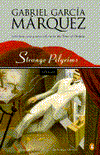
Strange Pilgrims by Gabriel Garcia Marquez

Cross posted from my blog:


Strange Pilgrims is a collection of short stories by Gabriel Garcia Marquez, written over a period of eighteen years.These short stories depict the day by day mystic and beautiful expediency that has made the Nobel Prize-winning author so engaging. All the twelve stories involve Latin American characters that are peripatetic throughout Europe. While some stories may strike the reader as being quite peculiar, others will flummox while demonstrating the splendour of the human spirit. The stories take us on a journey of sort. A whole gamut of emotions and feelings run through us while we reading the unusual stories.

A father moves with the body of his daughter who is just beautiful in death as she was in life, for her to be declared a saint. It’s father love at the ultimate. Then there is an ex-president who is expected to die and is looked after a couple who have little money to spare. A young sent to an asylum for no fault of hers. A panicked husband rushes his wife to a Parisian hospital for treatment of a cut finger, but never sees her again. A man on an overseas plane flight preoccupied in thought about the beauty of a lady passenger as she soundly sleeps next to him. An elderly prostitute trains her obedient puppy to weep at her grave because she has a haunting premonition about her own death and has no one other than the dog to cry at her death. In one story, two little boys experiment with light flowing as water.

Marquez displays his penchant for bringing to mind curiosity in the reader through his use of colourful description and captivating characters. Strange Pilgrims proves, once again, that Gabriel Garcia Marquez is one of the greatest storytellers of our time. The title of the book is apt as the reader indeed feels as if he is embarking on a pilgrim albeit a strange one.

Innocent Erendira by Gabriel Garcia Marquez

Cross posted from my blog:

Title: Innocent Erendira
Author: Gabriel Garcia Marquez

ISBN: 0140157522

Publishers: Penguin Books/1996

Pages: 183

Genre: Short Stories


One author I always end up picking is Marquez. I cannot resist him. Innocent Erendira is a collection of short stories spanning 25 years. Marquez explores, love, death, betrayal, power and duty in the short stories. One or two stories are not easy to interpret in one reading. There are eleven short stories and a novella---The Incredible and Sad Tale of Innocent Erendira and Her Heartless Grandmother.

The novella is a very poignant rendering about Erendira, who is only fourteen when we first meet her and is punished by her grand mother in a very diabolical manner when she accidentally burns her grand mother’s house. The way Erendira has to repay is heart rending. She runs away numerous times only to be brought back..

“The Sea of Last Time” has lots of imagery with unusual smell of the ocean. “Death Constant Beyond Love” is a strange love story where a senator falls in love with a nineteen year old when he had only six months to live.

In “The Third Resignation”, the last sentence ‘….he is so resigned to dying that he might as well die of resignation’ sums up the state of mind of a person who has been in coma for a long time.

One cannot read Marquez at just about any time. One has to have that mindset. As his writings are multi-layered, his characters are multi-faceted; sometimes there are open ends to his endings. Most of his stories are based on real life. His stories contain strange emotions, underlying mysteries and of course mastery over words and the world. Marquez appears to be obsessed with death and in those stories that is highlighted very well.

I would not recommend Marquez for the faint hearted or the die-hard romantic.

Leaf Storm by Gabriel Garcia Marquez

Cross-posted on Guiltless Reading.

Back Blurb: Drenched by rain, the town has been decaying ever since the banana company left. Its people are sullen and bitter, so when the doctor - a foreigner who ended up the most hated man in town - dies, there is no one to mourn him. But also living in the town is the Colonel, who is bound to honor a promise made many years ago. The Colonel and his family must bury the doctor, despite the inclination of their fellow inhabitants that his corpse be forgotten and left to rot.

1st line: I've seen a corpse for the first time.

My take: I was an instant fan of Gabo since I read 100 Years of Solitude some years ago. So it is indeed a treat to go back to his earlier writings and "reminisce," tracing how his stories and characters have grown over time. The setting, the town of Macondo, is one and the same; and the doctor was in fact introduced to the colonel by no less than Aureliano Buendia.

This is actually much more straightforward in terms of story. Leaf Storm does not rely too heavily on magical realism as compared to 100 Years, but you feel traces of it.

The book opens with the perspective of a young boy, uncomfortable in his clothes, no, his own skin ... as he views a dead body for the first time in his life. Along with his mother and his grandfather (the colonel), they are the only people in the village that came to keep watch over the corpse of the doctor.
Through an often-times confusing yet mesmerizing mishmash, the story of why the Colonel was bound to honor the dead doctor slowly unravels. Three perspectives ... their thoughts, their observations, their recollections ... these overlap each other. This was quite bewildering - on the one hand trying to figure out whose thoughts I was getting a glimpse of, and on the other hand, learning the bizarre story of this man who had pushed the hospitality of the Colonel to the limit and sparked the ire of the entire town.

In the end, no remembers nor really cares about the dead doctor. The story is not merely about a doctor but of an entire village. And more importantly, through the recollections, you go along on the same internal journey of the three characters from three generations.

When I read Gabo, I sometimes feel like I am suspended in between reality and a dream, as he brings a strangely eerie atmosphere with his descriptions. You can almost feel the sweat trickling down your own brow, breathe the thick heavy air, and know the stench of a dead body.

The term "leaf storm" was used as a metaphor for the arrival and departure of a banana company; with its entrance in Macondo came prosperity and abundance and with its departure, it again disappeared into oblivion. Just like the doctor.

One Hundred Years of Solitude by Gabriel Garcia Marquez (Laura's Review)


One Hundred Years of SolitudeGabriel Garcia Marquez
458 pages

First sentence: Many years later, as he faced the firing squad, Colonel Aureliano Buendia was to remember that distant afternoon when his father took him to discover ice.

Reflections: I learned something reading this book: I learned that I do not particularly care for "magical realism." I was initially attracted to this book because it's one of the "1001 books you must read before you die," and because the author has received such critical acclaim. It seemed like a must-read. When I decided to read it to satisfy both the "Reading across Borders" and "Spring Reading Thing" challenges, it became a must-read. I perservered, but in the end I am left with little to say about this book.

One Hundred Years of Solitude is a multi-generational family saga. Magical realism, according to Wikipedia, is "an artistic genre in which magical elements appear in an otherwise realistic setting." I was reminded of American folklore like Paul Bunyan. The characters had unusually strong abilities, and fantastic events like plagues happened often, and yet the setting in which this occurred was a sleepy rural village that you might find anywhere.

The writing is lyrical and in that sense I can understand why Marquez is so highly regarded. I just couldn't connect with the style and I think this may be one of those books that would be more appreciated if read as part of a literature course, where you can explore the themes and hidden meanings of events that take place in the story. As leisure reading, it left me flat.
My original review can be found here.

Strange Pilgrims by Gabriel Garcia Marquez

1g.jpg12 short stories about Latin Americans in Europe.

Back blurb: In Barcelona, an aging Brazilian prostitute trains her dog to weep at the grave she has chosen for herself. In Vienna, a woman parlays her gift for seeing the future into a fortune-telling position with a wealthy family. In Geneva, an ambulance driver and his wife take in the lonely, apparently dying ex-president of a Caribbean country, only to discover that his political ambition is very much intact.

In these twelve masterful stories about the lives of Latin Americans in Europe, Garcia Marquez conveys the particular amalgam of melancholy, tenacity, sorrow and aspiration that is the emigre experience.

My take: This is a fantastic book! If you aren't quite ready to plunge into Garcia Marquez's full length books, this one will give you a feel for how he writes. Despite some of these stories being only a few pages long, the stories will stay with you. They are beautifully un-verbose and showcase his gift for storytelling in magical, mystical prose. That is Garcia Marquez's magic.

If you've ever been in a foreign land, you can easily empathize with these characters' feelings of alienation and dislocation; of existing yet being unrooted from your realities and somehow making ones' self fit. The fit may not be quite right, but one manages.

Being of some Spanish influence, I believe that Filipinos (especially immigrants, overseas workers, and simply those visiting Europe and Americas) will see themselves in these characters and how they will tend to cling to familiar and often comforting traditions. You can change the exterior, but deep down you know who you are.

One of the most disturbing stories for me was the one where a woman simply wanted to use the phone ... but nonetheless ended up in an asylum. Over time she did become half insane. It is the tragedy of communicating, yet not being believed.

I have many favorite short stories here. Each story can be read leisurely in a few minutes. I suggest you not to rush through the entire thing in one sitting but savor each story, let it stay with you, and maybe even re-read it.

I've marked my favorite stories, through I loved each story in its own way.
  • Bon Voyage, Mr President
  • The Saint
  • *Sleeping Beauty and the Airplane
  • *I Sell My Dreams
  • "I Only Came to Use the Phone"
  • The Ghosts of August
  • María dos Prazeres
  • Seventeen Poisoned Englishmen
  • Tramontana
  • Miss Forbes's Summer of Happiness
  • *Light is Like Water
  • *The Trail of Your Blood in the Snow

The stories in this collection were originally written in a span of some 20 years, during the 70s and 80s. It wasn't published until 1992. Garcia Marquez draws from his own experiences as he spent some years as an exile from his native Colombia.


·
OLDER


© Read the NobelsMaira Gall