1991: Nadine Gordimer
Showing posts with label 1991: Nadine Gordimer. Show all posts

Gordimer, Nadine "Burger's Daughter"

1979

Reviewed by Marianne


I wanted to read a book by Nadine Gordimer for a long time. She is a prolific author, she's from South Africa, she writes about politics, she's a woman and she received the Nobel Prize for Literature, a lot of reasons why she should be on my list.

I certainly wouldn't call this an "easy read". The author's style is not very inviting, the flow … well, there is not really a flow. The conversations are not very clear, one often gets the impression that we're not supposed to know who is talking at the moment, whose thoughts we are following. The story jumps from one person to the next.

However, the topic of the novel is very good. The story is loosely based on the life of Bram Fischer and his family, especially his daughter. Bram Fischer was a South African lawyer, known for his anti-apartheid activism. He became most popular as Nelson Mandela's defence lawyer.

I did enjoy reading about the story even if I didn't enjoy reading the story very much. The book teaches us about South Africa, their history, the apartheid system and that there have been people fighting against it, even if there could have been more.

From the back cover:

"After the death of legendary anti-apartheid activist, Lionel Burger, his daughter Rosa finds herself adrift in a South Africa she no longer knows. Previously her life had been surrounded, created by politics. Now, confronting the left-wing legacy her father represented, as well as the rise of a militant Black Consciousness movement, she is involved in a 'children's revolt' of her own. But where and how will she find her own identity?

Emerging front the darkest days of apartheid, in its moods of elegy, homage and compassion, Burger's Daughter is a great political novel not only of South Africa but of the twentieth century."


Nadine Gordimer "who through her magnificent epic writing has - in the words of Alfred Nobel - been of very great benefit to humanity" received the Nobel Prize for Literature in 1991.


Read my other reviews of the Nobel Prize winners for Literature.  

Original Post on "Let's Read".

None to Accompany Me by Nadine Gordimer

Reviewed by Edith LaGraziana

For a long time South Africa was a place where a white minority saw itself in the right to exclude the vast coloured majority from power and even to determine the lives of its members in a way that nobody with working brains was likely to endure willingly, but in the end segregation and institutionalised discrimination couldn’t last even there. Thanks to the influence of Nelson Mandela and other moderate political activists the country saw a peaceful transition from the Apartheid regime to a democratic system based on equal rights for all her citizens. None to Accompany Me by Nadine Gordimer, the winner of the Nobel Prize in Literature 1991, shows some of the dramatic changes during this difficult period and their influence on the daily lives of South Africans.

Nadine Gorimer was born in Springs, Transvaal, Union of South Africa, in November 1923. Having been mainly home-taught and thus rather isolated during her childhood, she turned to writing early. Already at the age of 15 years her first short story for children appeared in a newspaper and as a sixteen-year-old she made her literary debut in adult fiction. The author’s first novel, The Lying Days, came out in 1953. For the moral and racial issues that the author dealt with critically in her work, the Apartheid regime banned novels like A World of Strangers (1958), The Late Bourgeois World (1966), Burger's Daughter (1979), and July's People (1981). Others of her important works published before she was awarded the Nobel Prize in Literature in 1991 are Occasion for Loving (1963), A Guest of Honour (1970), and The Conservationist (1974). None to Accompany Me (1994), The House Gun (1998), The Pickup (2001), and Get a Life (2005) count among the most notable novels of her late years. In addition to her novels the author brought out a great number of short story collections and essays. Nadine Gordimer died in Johannesburg, South Africa, in July 2014.

The scene of None to Accompany Me is Johannesburg in South Africa where Vera and Bennet “Ben” Stark live in an old house that had been part of the divorce agreement with her first husband. When the latter had returned from World War II, she had already had a lover, Ben, whom she married immediately after the divorce… and betrayed with her ex-husband once never knowing if her son Ivan was her first husband’s or Ben’s really. When Nelson Mandela is released from prison in 1990 and the Apartheid regime falls, Vera and Ben have been married for over forty years, happily married although Ben built his life around Vera sacrificing even his dream of being a sculptor and although in her forties Vera had an affair with a man fifteen or more years her junior. The couple has a son, Ivan, and a daughter, Annie. Ever since Vera resumed work after maternity leave, she has been a lawyer with the Legal Foundation and fighting for the rights of coloured clients although discriminating laws hampered her efforts a lot. The end of Apartheid brings new challenges with black communities claiming back the lands of their ancestors from white farmers like Tertius Odendaal who aren’t even willing to talk to them. By and by long-time political exiles like Sibongile “Sally” and Didymus “Didy” Maqoma, who used to be friends with the Starks, return to South Africa to seize the opportunity to create a just South Africa. In the climate of political uncertainty violence spreads across the country. On a deserted road on the way back from a fieldtrip, Vera Stark and her assistant are assaulted and robbed. She is wounded in the leg by a bullet and he is shot into the chest, but survives at first and dies later from unexpected complications. On the political field Sally Maqoma becomes a rising star, while her husband who had been the real activist of the couple is reduced to a role in the background. At the same time Vera Stark gets a chance to work on the new constitution and becomes even more absorbed into her work leaving her husband to himself with his failed business. Slowly her former client, Zeph Rapulana, who was a squatter-camp leader and belongs now to the new black middle-class, is taking the place of her best friend, confident and adviser.

Like real life None to Accompany Me interweaves the personal fates of its characters with events and atmosphere surrounding them. The setting is South Africa in the early 1990s. As is (or should be) generally known, the period is one of dramatic change on the political level, but also the lives of the Starks, the Maqomas and people like them are taking a new direction. There’s nothing extraordinary about the characters portrayed in the novel, not about anything they do, nor about anything that happens to them. They are average people coping best they can with the new situation. Vera Stark as the female protagonist of the third-person narrative also finds herself re-evaluating her marriage and discovering how shadows of the past like her first husband and her lover Otto Abarbanel fit in. She realises that the ultimate intimacy with a man that she yearns for is impossible and that being the beloved centre and only purpose of another person is a burden that she doesn’t want to carry any longer. She wants to be alone and on her own with none to accompany her – thus the title. The author tells the story of her protagonists representing South African people with such great narrative skill that it absorbs the reader right away. Characters, moods and events feel entirely drawn from real life although they are fiction embedded in historical facts. The language of Nadine Gordimer is rich in powerful images and easy to read although she uses several idiomatic expressions from her country (at least I believe that it’s for this reason that I didn’t know them). Also her clear and critical mind, which made that several of her books were banned by the Apartheid regime for a time, is obvious in every line.

Overall I enjoyed reading None to Accompany Me by Nadine Gordimer very much. It surely isn’t the novel for which the author is best known, but it makes see despite all that the Nobel Prize in Literature of 1991 didn’t go into the wrong direction. In any case it’s another excellent book to which I gladly dedicated a post and which I recommend warmly.

Original post on Edith's Miscellany:

The Conservationist by Nadine Gordimer (Lisa Hill, ANZ LitLovers)


I'm sure there were many things I missed in this complex movel, but then, I don't expect Nobel Prize winning authors to be easy-to-read...

I read The Conservationist in a kind of appalled fascination, repelled by the language South African Whites use to talk to and about the Blacks in the book. Nadine Gordimer, the Nobel Prize winning author of this Booker Prize winning story, depicts her characters routinely using the language of master and servant in the most disparaging way, a kind of amused contempt exacerbated by its casual delivery. Reading it, one feels besmirched simply by being privy to the perspective of its White anti-hero, Mehring.

However as the tale unfolded, the main thing I noticed about The Conservationist was the sense of isolation of this principal character, Mehring. Unlike the dispossessed and powerless characters who work for and around him and enjoy companionable relationships with others, he – the rich, powerful white man in South Africa under Apartheid – is alone. As the story progresses he isolates himself even more, refusing all invitations and camping out in increasing discomfort rather than participate in society. Eventually his friends give up on him and the invitations dry up…

I read and blogged this book on February 10th 2011. To read the rest of my review please visit
http://anzlitlovers.wordpress.com/2011/02/10/the-conservationist-by-nadine-gordimer/

Cross posted at ANZ LitLovers and The Complete Booker

The House Gun by Nadine Gordimer

The House Gun by Nadine Gordimer

From Library Journal: Harald and Claudia, highly successful professionals (he heads up an insurance company, she is a physician), find their comfortable life in post-apartheid South Africa turned upside down when their only son is accused of murdering one of his housemates, using the communal "house gun" they had purchased for protection. The parents are dumbfounded when Duncan does not deny the crime. How could their son be a murderer, and are they somehow to blame? Duncan acted out of jealousy, but was it heterosexual jealousy or something else? He is going to be defended by a black attorney. Will the attorney's lack of courtroom experience be a liability, or will his race favorably influence the judge? Harald and Claudia are ashamed to find themselves asking these questions.

My take: I felt like I was holding my breath throughout the whole book, expecting something earthshaking to happen. But a third into it, I was still waiting ... halfway into it, still waiting... and when the moment arrived, arrrrggghhh, is that IT?

Not exactly a page-turner, but an incisive look into the psychology of parents to their child. How well do you really know your child? If your son were accused of murder, would you feel obligated to believe him as innocent? To what lengths would you protect your son?

It also examines to a lesser degree white-black relations and power play in South Africa.

Originally posted on my blog Guiltless Reading.

My Son's Story by Nadine Gordimer

My Son's Story by Nadine Gordimer

From Publishers Weekly: Nobel Prize-winning author Gordimer's story of segregated South Africa focuses on Sonny, a black teacher whose revolutionary activities, imprisonment and extramarital affair with a white human rights activist profoundly affect his family. According to PW, "The novel is eloquent in its understated prose and anguished understanding of moral complexities."

Quick take: After a few false starts and stops, I finally got into this extremely well-told tale of apartheid and revolution in South Africa. The beauty of it is that the secret lives of each family member can get so engrossing, that you seem to actually know them.

The Conservationist by Nadine Gordimer

The Conservationist
Nadine Gordimer
267 pages

The Conservationist is an in-depth character study of Mehring, a South African businessman-cum-farmer. His success in industry provided the means to buy a 400-acre farm, which serves primarily as a tax write-off. In his quest for material success, Mehring has lost his wife and a mistress. His teenage son attends school some distance away, and has become increasingly independent -- estranged, perhaps -- from his father. Mehring mistakenly views interaction with the black laborers on his farm as a meaningful relationship. In reality, the South African class structure ensures their relationship remains distant.

I found Mehring to be a fairly despicable and pathetic character, which I believe was Gordimer's intent. He is a philanderer, at one point fondling a young lady he'd never met for the better part of a long-haul flight. Yech. And while at times he seems to appreciate the natural beauty of his farm, he has no one to share it with him. His time spent at the farm is empty, a way to pass the weekend or to hide from social obligations.

This was a difficult book to read because the main character was so unlikeable, and it revolved much more around character than plot. However, Gordimer writes some pretty amazing, descriptive prose that brought the South African scenery to life. Despite my rather lukewarm reaction to this particular novel, I will definitely be reading more of her work. ( )

My original review can be found here.

The Pickup by Nadine Gordimer

The Pickup by Nadine Gordimer is one of the books I read for my Read the nobels challenge. I finished it a few days ago, but didn't start writing my review because I was afraid I wouldn't do the book justice.

The story is set in modern-day South Africa. The main character is Julie Summers, a white young woman, daughter of a prominent citizen, who lives in the Johannesburg suburb. When her car breaks down, she meets a black man who calls himself Abdu, a Muslim immigrant who is in the country illegally, seeking refuge from his unnamed Arab homeland.

Julie and Abdu soon become lovers, and she tries to bring him into her own inner circle--introducing him to her friends and her father. But when the authorities discover Abdu, he is forced to go back to his country. Julie decides to follow him: the two marry and head off to the small African country where Abdu came from. There, Julie learns Abdu's real name, Ibrahim, for the first time.

Now Julie is the outsiders, and must struggle to be accepted by Ibrahim's family. But while Ibrahim tries to escape again, applying for a visa to every Western country he knows, Julie likes contemplating the desert and teaching English to the villagers.

Ultimately, Julie and Ibrahim love each other, but are unable to understand each other's background and motives. Nadine Gordimer portarys here a relationship between two people of different culture, who have a strong physical attraction, but cannot understand each other completely.

This is a very interesting novel, one I'd recommend to people interested in cross-cultural relationships.

Cross-posted at Out of the Blue

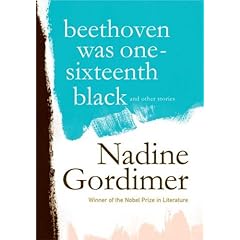
Beethoven Was One-Sixteenth Black by Nadine Gordimer


Beethoven Was One-Sixteenth Black, a collection of short stories by South African Nobel Prize winner Nadine Gordimer, has its hits and misses. The misses include a story about a tapeworm from the tapeworm’s perspective; a reminiscence of a cockroach trapped in a typewriter that doesn’t rise above casual anecdote; and the self-indulgent “Dreaming of the Dead” in which Gordimer recounts a dream of having dinner with Susan Sontag and two other deceased friends.

The hits more than make up for weaknesses in the collection. Gordimer’s elegant writing raises ordinary events above the tawdry and mundane, pulling out bigger ideas and themes, including the theme of personal identity in a changing world. In the title story, for instance, the protagonist goes on a half-hearted search for black relatives possibly descended from his white, diamond prospecting great-grandfather. Gordimer subtly makes it clear that his search is driven by more than genealogical curiosity as he searches for a family that would unify his prior anti-apartheid political efforts and his personal history.

Likewise, in “A Beneficiary,” a young woman faced with the early death of her actress mother struggles to determine which is her real identity – daughter of the famous actor who sired her, or the loving businessman who raised her knowing she was the product of his wife’s brief, illicit affair.
Gordimer is at her best writing about marriage and its challenges. Adultery and sexual history are common elements. In “Alternative Endings,” for example, Gordimer examines adulterous affairs in three stories, using a different one of the five senses as the focus of each. Unfortunately, while one of the three involves hearing and another scent, it is entirely unclear which sense was featured in the third. More confusing, especially since this trilogy ends the book, is why Gordimer didn’t write five stories so as to feature each of the five senses.

Overall, this is a worthwhile collection of stories and a good introduction to Gordimer’s sophisticated writing.

Nadine Gordimer on Racism


Here she describes her escape from the racist ideology she has grown up with.

A Beneficiary by Nadine Gordimer


Caches of old papers are like graves; you shouldn't open them.
- From A Beneficiary by Nadine Gordimer

I am a bit embarrassed that I have never read anything by Nadine Gordimer until now. This wonderful short story was published in the New Yorker earlier this year and I read it as part of the 21st Fiction Yahoo Group who are reading one on-line short story each month in addition to their regular schedule of novel reads.

The story opens by introducing the main character, Charlotte (aka Charlie) whose mother, an actress, has just died. While packing up her mother's belongings, Charlie stumbles upon an old letter which becomes the catalyst for the rest of the story. The ending is immensely satisfying with a bigger message about what it means to be a parent.

Gordimer is an artist with words, painting her characters so lifelike that the reader forgets they are reading fiction. I was completely entranced by this story which I read in less than an hour.

After reading this little gem, I am motivated to pick up other works of this South African Nobel Laureate (Nobel Prize in Literature in 1991). Gordimer has written 14 novels and 11 short story collections.

I rate this one a 5/5 and highly recommend it.
·
OLDER


© Read the NobelsMaira Gall