gautami
Showing posts with label gautami. Show all posts

My Name is Red by Orhan Pamuk

Crossposted from my blog:

Title: My Name is Red
Author: Orhan Pamuk
ISBN: 0375706852
Publisher: Vintage International/2001
Pages: 413

I had started this book in January. For some reason, it stayed at page 43 for a few months. I again picked it up in April. I only read upto page 59. However, finally I decided to finish it this week. Today I did. You can say that I plodded through the book. It could only hold my interest after I had read it half way through.

This book has many layers to it. A murder mystery, a love story and also speaks out about Islamic society. One can feel the tensions throughout for the rise and fall of various empires which is told by the way of miniature art. At some point in the book, we do not care who the murder is but get involved in the treachery of politics, the love affair and want to know more about the Islamic society. Being an Indian, and knowing a bit about Islam did help me.

There is clash between cultures. Between spirituality and materialism. Between getting fame at whatever cost and bowing to art. Between God's will and man's doing. How does one define sin? Can one justify it? Does it merge somewhere? Is there really a fine line? These are few of the questions one asks while reading. A few get answered, a few don't. That does not take away anything from the book. We can see the eternal conflict between the old and new, and tradition and change i.e., that of East and West. Then there are those artists who only depend on copying, others who want to take in the western influence to show other perceptions.

This book has been narrated in many voices, mostly human. However, a few include a horse, a dog, a tree and a coin. Also we see voice of death. One tends to get different perception in this way of speaking. The novel begins with the voice of a dead person, the recently killed Elegant Effendi. His murderer is a recurring character, telling his story both anonymously and also as a character not identified by the others as being the killer, until the end.

The setting of the book is the late 16th century, in Istanbul. Elegant Effendi and his murderer are both artists: miniaturists and illustrators. Other important characters are Enishte Effendi, a master artist, his nephew, called Black, who too is a miniaturist, and his daughter Shekure. Black had fallen in love with Shekure, but it was not possible for them to marry. Black left Istanbul and returned after twelve years. Meanwhile, Shekure got married three years after he left, and has two sons. However her husband disappeared years ago and is presumed to be dead. Now her husband's brother Hasan, wants to marry her as does Black.

Pamuk's descriptions and evocations are like the miniatures he describes. Very detailed, very pictursque and paying attention to finer nuances which can be used to for different effects, at different times. It is a fascinating read, no doubt. However, it is very slow in the beginning. One has to literally plod through it to get to the end. That is worthwhile. I must mention it again, that this is not an effortless read. I am in no hurry read other books by him!

Siddhartha by Hermann Hesse (gautami)

Cross posted from: My Own Little Reading Room

Title: Siddhartha

Author: Hermann Hesse
ISBN: 8187981830
Publisher: Indialog/2005
Pages: 167
rating: 4/5


Hermann Hesse wrote it in 1923, and it still is continues to be good read for those who are searching themselves. It is an allegorical story filled with both Eastern and Western philosophy. Siddhartha, a brahmin boy leaves home along with his friend Govinda to fill the thirst in his mind. He goes to leave with the samanas, wandering ascetics, begging for food and spending his days in meditation. Even that does not help him attaining what he truly seeks. Liberation from everything. Nirvana. Then he meets Gotama. This meeting with the Buddha has an unexpected effect on him. He realizes that teachers cannot teach him what he is seeking and that is upto him find his own way to salvation.

Siddhartha's life is shown to be a parallel of Gotama, the Buddha's life. Awakening of the mind and ultimate knowledge is what they both seek. Gotama had done it much before him and Siddhartha has to embark on it all by himself. Siddhartha’s life is interesting as he does not take the easy route. Moving through myriads of experiences he finally attains enlightenment.

Govinda is a shadow of Siddhartha in the beginning but comes out on his own. This too teaches us that it is on us to seek, find and know. In the quest of peace and truth, each of us is alone. We all have to make that journey all by ourselves. No amount of teaching will do it for us.

This is a fairly easy book to read and understand. The philosophy is explained in a simplistic manner. This book has survived eigth decades...And no, this is not a story about Gautama Buddha. It is the story about Siddhartha. Well, I felt better after reading it.

Collected Stories by Gabriel Garcia Marquez

Cross posted from: My Own Little Reading Room

Title: Collected Stories

Author: Gabriel Garcia Marquez
ISBN: 0-14-015756-5
Publisher: Penguin Books Ltd/1996
Pages: 292
rating: 2.5/5


Marquez is one author, I love to read. However, I need a lot of time in between his books. I picked this after a very long time. It is a collection of twenty six short stories (originally published in three volumes, Leaf Storm and Other Stories, No One Writes to the Colonel and Other Stories, and Innocent Erendira and Other Stories). A few I had read before in another of his book, Innocent Erendira. These are given in chronological order of their publication.

Marquez won the Nobel Prize in 1982. I do not think, he needs any introduction. However, what most of us get, is to read his translated works as he wrote in Spanish. That is a disadvantage, I think.

This book has three parts and shows us the growth of Marquez as a writer. I found the initial stories not too good. I just could not relate to those. At some instances, I had to re-read and that did not help me a bit. I found it confusing, confounded and disappointed. The Third Resignation is about a seven year old boy who falls into a coma and grows to adulthood in a coffin mother’s house. The Other Side Of Death has shades of a Allan Poe nightmare.

There Are No Thieves In This Town
is about man who steals three billiard balls from a pool hall and finally is foolish about the whole thing. One Of These Days is about a corrupt mayor. Dialogue With The Mirror is incomprehensible. Eyes Of A Blue Dog is a story in a dream which speaks of a doomed relationship between two people who know each other only in dream, and not in the real world.

In The Sea of Lost Time, the island is pervaded with the fragrance of roses in the sea. The smell triggers changes on the island and thats about it, as colonial misdeeds still continue. The Monologue Of Isabel Watching It Rain In Macondo is about a town wholly destroyed by incessant rain. In The Handsomest Drowned Man In The World children playing by the sea see a corpse approaching them. The women go ga-ga over him and men are jealous of him. He is named Esteban and a whole myth is built around him, Then, after a proper funeral, he is thrown back into the sea.

In
Eva Is Inside Her Cat, Eva is a spirit who can take over any living thing. She is an unbalanced being and the story can be interpreted as consequences of oppression to the mind, or soul. Only part that redeems the book is the novella Innocent Erendira, which I had read before. The novella is a very poignant rendering about Erendira, who is only fourteen when we first meet her and is punished by her grand mother in a very diabolical manner when she accidentally burns her grand mother’s house. The way Erendira has to repay is heart rending. She runs away numerous times only to be brought back..

I know I will continue reading Marquez. However, this book left me wanting more. I can't even mention how a few stories were not worth reading. I just left those halfway through. Here I found, Marquez has got repetitive in his symbolism and in a few instances, the stories do not make any kind of sense. For light readers, it is strictly a no-no!

Gautami's selections

Here are my choices:

# 2006 - Orhan Pamuk---My Name is Red
# 2004 - Elfriede Jelinek---The Piano Teacher
# 1993 - Toni Morrison----Beloved
# 1982 - Gabriel García Márquez--1) Collected Stories
2) Love in the Time of Cholera

# 1967 - Miguel Angel Asturias--Cyclone
# 1962 - John Steinbeck----The Grapes of Wrath
# 1948 - T.S. Eliot----The Waste Land--To be re-read
# 1946 - Hermann Hesse---Siddhartha

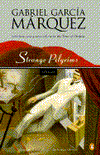
Strange Pilgrims by Gabriel Garcia Marquez

Cross posted from my blog:


Strange Pilgrims is a collection of short stories by Gabriel Garcia Marquez, written over a period of eighteen years.These short stories depict the day by day mystic and beautiful expediency that has made the Nobel Prize-winning author so engaging. All the twelve stories involve Latin American characters that are peripatetic throughout Europe. While some stories may strike the reader as being quite peculiar, others will flummox while demonstrating the splendour of the human spirit. The stories take us on a journey of sort. A whole gamut of emotions and feelings run through us while we reading the unusual stories.

A father moves with the body of his daughter who is just beautiful in death as she was in life, for her to be declared a saint. It’s father love at the ultimate. Then there is an ex-president who is expected to die and is looked after a couple who have little money to spare. A young sent to an asylum for no fault of hers. A panicked husband rushes his wife to a Parisian hospital for treatment of a cut finger, but never sees her again. A man on an overseas plane flight preoccupied in thought about the beauty of a lady passenger as she soundly sleeps next to him. An elderly prostitute trains her obedient puppy to weep at her grave because she has a haunting premonition about her own death and has no one other than the dog to cry at her death. In one story, two little boys experiment with light flowing as water.

Marquez displays his penchant for bringing to mind curiosity in the reader through his use of colourful description and captivating characters. Strange Pilgrims proves, once again, that Gabriel Garcia Marquez is one of the greatest storytellers of our time. The title of the book is apt as the reader indeed feels as if he is embarking on a pilgrim albeit a strange one.

Nobel Laureates I have read so far

  • Wednesday, November 21, 2007

Crossposted from my blog..

I have listed the Nobel Laureates and their books I have read so far. I have not reviewed all of those on my blog as I read a few long time back. If I do, I will link those here. I am in the process of reading another book by Steinbeck,
three by Marquez and one by Orhan Pamuk.

1907 - Rudyard Kipling
Jungle Book
The Second Jungle Book
Kim
Collected stories

1913 - Rabindranath Tagore
Gitanjali
Binodini-a novel
The Fugitive


1925 - George Bernard Shaw
Arms and the Man
Pygmalion

1936 - Eugene O'Neill
Desire Under the Elms

1938 - Pearl S Buck
The Townsman

1946 - Hermann Hesse
Siddhartha

1948 - T S Eliot
Prufrock and Other Observations
The Waste Land
Murder in the Cathedral
The Confidential Clerk

1950 - Bertrand Russell
Introduction to Mathematical Philosophy
In Praise of Idleness

1954 - Ernest Hemingway
A Farewell to Arms
For Whom the Bell Tolls
The Old Man and the Sea
Islands in the Stream

1962 - John Steinbeck
The Moon Is Down
The Pearl
East of Eden

1965 - Mikhail Sholokhov
And Quiet Flows the Don

1971 - Pablo Neruda
Pablo Neruda : The Early Poems

1982 - Gabriel Garcia Marquez
Innocent Eréndira, and Other Stories
Strange Pilgrims : Twelve Stories

2001 - V S Naipaul
A House for Mr. Biswas

Innocent Erendira by Gabriel Garcia Marquez

Cross posted from my blog:

Title: Innocent Erendira
Author: Gabriel Garcia Marquez

ISBN: 0140157522

Publishers: Penguin Books/1996

Pages: 183

Genre: Short Stories


One author I always end up picking is Marquez. I cannot resist him. Innocent Erendira is a collection of short stories spanning 25 years. Marquez explores, love, death, betrayal, power and duty in the short stories. One or two stories are not easy to interpret in one reading. There are eleven short stories and a novella---The Incredible and Sad Tale of Innocent Erendira and Her Heartless Grandmother.

The novella is a very poignant rendering about Erendira, who is only fourteen when we first meet her and is punished by her grand mother in a very diabolical manner when she accidentally burns her grand mother’s house. The way Erendira has to repay is heart rending. She runs away numerous times only to be brought back..

“The Sea of Last Time” has lots of imagery with unusual smell of the ocean. “Death Constant Beyond Love” is a strange love story where a senator falls in love with a nineteen year old when he had only six months to live.

In “The Third Resignation”, the last sentence ‘….he is so resigned to dying that he might as well die of resignation’ sums up the state of mind of a person who has been in coma for a long time.

One cannot read Marquez at just about any time. One has to have that mindset. As his writings are multi-layered, his characters are multi-faceted; sometimes there are open ends to his endings. Most of his stories are based on real life. His stories contain strange emotions, underlying mysteries and of course mastery over words and the world. Marquez appears to be obsessed with death and in those stories that is highlighted very well.

I would not recommend Marquez for the faint hearted or the die-hard romantic.

Kim by Rudyard Kipling

Cross posted from my blog...

Title: Kim
Author: Rudyard Kipling
ISBN-13: 9780140183528

Publisher: Penguin Group/338pages
First Published: 1901
Kim is a story about a British orphan about thirteen years of age who has been raised on the streets of Lahore, now in Pakistan. He speaks fluent Hindi, understands assorted dialects and, is well versed in whirl of religions and cultures. He takes to the road as a disciple of a wandering Tibetan priest in search of a mythical holy river with healing powers. Along the way, he has a chance meeting with his deceased father's old army regiment and his identity is revealed to him. The army sends him to an English language Catholic school in the south, but his underlying value, because of his knowledge of local language and understanding of culture, is quickly made use by a member of the British secret service.

Kim is not a children’s book. A child may be the main character, but the book is too philosophical and filled with complex human behaviour to be of much interest to children. The main thrush of the book is the relationship between Kim and the Red Lama, the basic story of two people, one an orphan boy and the other an elderly mystic, finding many of the things they are seeking in caring for and looking after one another.

In Kim, Kipling characterizes all the good of India while playing down the contrasts. He shows us what India would have been like in an ideal situation of mutual tolerance. Kipling’s observations are remarkable and one realizes from time to time that it is not the writer’s imagination about a period long gone but that he was in fact a part of that period. The sights, sounds, phrases, references, and personalities are entirely authentic. Kipling captures the sound, smell, and colour of India in the early part of the 20th century like no one else. He was a writer gifted with an acute sense of observation and a keen eye for details.

Another angle on the story is what is says about modern human intelligence operations. The leading British intelligent agent recognizes that Kim has language and culture skills that cannot be taught in any academy.

The story takes place after the Indian mutiny of 1857when many families were divided by violence. That period was a time of immense upheaval in India. It went from being a country made up of many native princely states with Englishmen as merchants to one unified under the flag of England. There was tension between the English in India and the Indians. There was also a staunch love of India by those same ruling Englishmen and women. Even Kipling did not envisage that the mutiny of 1858 was a step in the fight for India's independence. He was convinced that what England was doing was right despite his love for India. There in lies the irony.

At places, one has to plod through despite the poetic language. Still this is well worth the read. It does give a good glimpse of British rule in India.

East of Eden by John Steinbeck

John Steinbeck’s “East of Eden” is a fascinating book that traces out story of two generations of two families whose lives are somehow interlinked. We can say that it's by chance rather than design. Their lives are correlated to land and nature as was the norm in those times and even now we can see that in our world. In that way nothing has changed in all those years. The rebuilding of the man in the face of adversity, the tenacity of mind and body, mind eternally seeking and questioning, trying to find answers for his faith and belief and in some case just acceptance.

Are we not all questing to find answers about ourselves, our convictions or about the paradox called life?

It has well etched characters….so well that we can identify with them.

LEE: I think he is one of best character in the book. He is unlike any other servant. He himself says that a servant can be the master of the man he is serving. But we never see him imposing on Adam Trask at any place. He is more of a family to them than anyone else. He is the one who brings up Cal and Aron single handedly. It is he who keeps them together. He is practical, down to earth and lots of philosophy going inside him. Even when he leaves for his dream bookstore, we want him to come back as soon as he leaves. He does come back when he realizes that it is only thing he wants and they are the only family he ever had. Hence we see him unpacking his things and making a home for himself. It is he who teaches about choices and from him we learn that it is what we want ourselves to be and not the blood, which flows within us. His study of the Old Testament goes much beyond mere academic interest. He reminds us of Timshel----“thou Mayest.”

LISA: Somehow she made a great impression in my mind. Loaded with faith, belief, practicality and hard work, she knew how to look after her large family. She with her no frills, no nonsense attitude reminds me of the matriarchs of our own land. As long as there is plenty of food on the table, other things did not bother her. She kept her family together and accepted life and death, as they should be.

TOM and DESSI are like any other brother and sister…. loving and affectionate. Despite that they could not communicate with each other as both had a few demons to slay and did not want the other to worry about those. Maybe if they had shared, both would have lived. Maybe….who knows…

CAL and ARON: of the twins Cal is more interesting. He behaves like any other sibling in the circumstances where he knows that his brother is more loved and favoured. Just one look at Aron, everyone loves him but Cal has to fight for it. Most of us have gone through these phases in some way or the other. So we can identify with him. Best thing about Cal is, he knows what he does is wrong but in his jealousy he does not realize it. It comes later after the deed is done. He has deep love for his father and his twin, Aron. He does not hate his mother either. He is simply indifferent towards her.

Aron lives in a world of his own. Where everything is perfect. Only goodness and brightness prevails. Even the girl he loves is perfect in his eyes with no flaws. He cannot accept imperfection. He cannot accept that his mother is a whore. He seeks escape the only way he knows by joining the army.

CATHY/KATE: Much has been written about her. She being evil, a monster, what drove her to it no one knows. But we do see flashes of loneliness. I think even she was not aware of those. In her world, there is no place for any one other than herself…no one and nothing. She is beyond redemption.

Like in this timeless novel, East of Eden, we can still find people just like those. We have Sams, Lees, Adams, Charles, Lisas, Toms, Cals, Arons and above all Cathys amongst us. Good and evil have to coexist or how do we distinguish one from the other. If there is GOD, there is SATAN too.
·
OLDER


© Read the NobelsMaira Gall