1938: Pearl S. Buck
Showing posts with label 1938: Pearl S. Buck. Show all posts

Peony (1948), by Pearl S Buck


Pearl S Buck (1892-1973) was not the first woman to win the Nobel Prize, (that honour went to Swedish author Selma Lagerlöf in 1909) but she was the first woman to win it for literature written in English.  However, as the daughter of American missionaries who spent most of her life in Zhenjiang, China  before returning to the US in 1935, she is best known for her writing about China.  The Nobel citation was "for her rich and truly epic descriptions of peasant life in China and for her biographical masterpieces".  Of these I have read The Good Earth (1931) in the days before I kept a blog or a reading journal, and I've have previously reviewed her Letter from Peking, (1957).   This first part of this review of Peony, (1948) comes from my 2006 Reading Journal #11, followed by my more recent thoughts from 2020. 

***

Peony, is a deceptively simple story of star-crossed lovers divided by race, religion and class.  Written in 1948, it's an historical novel which explores the role of women in mid 19th century China.

Peony is a bondmaid in a Jewish family who lived in Kaifeng in China in the 1850s.  In the edition I read there was an Afterword*  which confirmed that there had been Jews in Kaifeng for a very long time, and that they were well-accepted by the Chinese as they never were elsewhere.  However, according to Buck, it was this assimilation which led to marrying 'out' and the gradual loss of their culture and religion.

*Probably by Wendy R. Abraham, but the book was from the library so I can't now be sure.

Although the novel is dominated by the story of Peony's doomed love for David, the son of the house of ben Ezra, it also explores Jewish beliefs and is critical of some aspects of their religion.

There is extensive dialogue about the incompatibility of the 19th century Chinese view of the world and the fundamentals of the Jewish religion.  Through the character of Kao Lien, a Chinese Jew, Buck is quite explicit about the separateness of Jews making them vulnerable to hatreds, and he tells his daughter Kueilin that she will not be happy if she marries into that family because they are a sorrowful people and they worship a cruel god.  Kung Chen, seeking to learn more about Judaism, rejects the concept of a Chosen People and tells the Rabbi that if there is a god, he would not select only The Chosen for salvation because under Heaven we are all one family. 

***

Wikipedia tells me that Buck was, in the US, a prominent advocate of the rights of women and minority groups, but I am uneasy about anything that suggests any kind of justification for anti-Semitism, or which implies that minorities are in any way responsible for the irrational hatreds of other people.  However, though it is now well-established that the German genocide targeted all Jews, whether secular or orthodox, or assimilated for generations or not, I am inclined to think that Buck was, in the immediate aftermath of WW2, searching for some kind of explanation for the Holocaust and the comparative tolerance of the Chinese.  To put it another way, her response to the horror of the Holocaust may have been to explore within the society that she knew so well, the costs and benefits of assimilation as protection against it ever happening again.

I think now that Buck in this novel was exploring the vexed question of Jewish assimilation and identity.  Hatreds that fuelled pogroms elsewhere did not occur in China because the Jews were absorbed into Chinese society, but this was at the cost of their traditions and identity.  David's mother Madame Ezra represents orthodox separatists who feared the loss of a distinctive Jewish identity, and her intransigent refusal to modify her principles even at the cost of her son's happiness, shows the strength of her determination to protect her family's faith.

Buck's interest in this issue may also have been influenced by her own experience of being in a minority faith.  She was the daughter of Presbyterian missionaries, so she may also have been critiquing the contrasting worlds of restrictive religions in general, in terms of how they are incompatible with a more light-hearted, humanistic approach to life:

Pearl recalled in her memoir that she lived in "several worlds", one a "small, white, clean Presbyterian world of my parents", and the other the "big, loving merry not-too-clean Chinese world", and there was no communication between them. (Pearl Buck's page at Wikipedia, viewed 4/11/20)

I'd be interested to hear the interpretations of others who have read this book more recently...

Peony, by Pearl S Buck, first published in 1948, borrowed from Kingston Library.

© Lisa Hill

Cross-posted at ANZ LitLovers where you can join in a conversation about the book if you want to.


Letter from Peking (1957), by Pearl S Buck


This book is a bit of a find... a hardback first edition of a Nobel Prize winner, still in its original dust-jacket. And the Nobel Prize winner is none other than Pearl S. Buck.  This is her Wikipedia entry (links removed):
Pearl Sydenstricker Buck (June 26, 1892 – March 6, 1973; also known by her Chinese name Sai Zhenzhu; Chinese: 賽珍珠) was an American writer and novelist. As the daughter of missionaries, Buck spent most of her life before 1934 in Zhenjiang, China. Her novel The Good Earth was the best-selling fiction book in the United States in 1931 and 1932 and won the Pulitzer Prize in 1932. In 1938, she was awarded the Nobel Prize in Literature "for her rich and truly epic descriptions of peasant life in China and for her biographical masterpieces". She was the first American woman to win the Nobel Prize for Literature.

And also one of only fourteen women to win the prize.

My copy of The Good Earth is an old 1970s paperback so it was nice to see Letter from Peking with its quaint illustration.  The artist, CWB, whoever he/she was, has captured not only the lovely autumn trees on a Vermont farm, but also the body language of a woman who can't quite believe what she is reading in her letter.  But, prompted by the blurb's statement that the book is wholly without propagandist aim I think there may have also been another purpose to this illustration, and that may have been to reassure potential readers with the book's American setting.  It was 1957, during the Cold War, and the Communist Revolution in China had consolidated its grip on power.  As we see in the book, amongst ordinary people there was a real fear of China and suspicion of anyone favourable to it.  Even a writer as well-loved as Pearl Buck may have needed to be careful.

The contents of the letter are not fully revealed until the end of the book, but Gerald's words haunt the story.  This couple has been separated for five years now, Gerald staying in China after the Communists took power, while sending Elizabeth and their son Rennie back to safety in America.  Letters have been intermittent, and always sent via clandestine means.  This one has been mailed from Hong Kong, and it is inside an envelope addressed by a strange hand.

I read the letter, over and over again.  In the silent autumn air, no wind stirring, the bright leaves floated down.  I could hear Gerald's voice speaking the words he had written.

My dear wife:

First, before I say what must be said, let me tell you that I love you. Whatever I do now, remember that it is you I love. If you never receive a letter from me again, know that in my heart I write you every day. (p.10) 

The rest of the letter affects her so profoundly that she puts it away in a drawer, determined never to read it again.  But she is not angry.  Because Gerald is bi-racial and she had to stand up to her racist mother to marry him, she believes that there is something very special about their love and is determined not to relinquish it.  This faith in her husband's love and fidelity sustains her over the difficult days ahead.

Born in China to a Chinese woman and his American father known as 'Baba', Gerald met Elizabeth when he came to America to study at Harvard.  She went with him when he returned to his homeland, and they lived very happily there, their contentment marred only by the death of a baby daughter.  Americans were not welcome after the Revolution, but it was always intended that the separation would be temporary and that they would be reunited. They did not expect suspicion to fall on Gerald because he had always been accepted in China as one of their own.

Rennie, as he comes of age in Vermont, however, is uncomfortable about his Chinese heritage.  He is not obviously bi-racial in appearance and he conceals his parentage from his first girlfriend.  Elizabeth is uneasy about this fledgling relationship, and meddles, using his Chinese antecedents to expose the racism of the girl and her family.  Like any all-American boy, Rennie takes a dim view of this.

The story is told entirely from Elizabeth's point-of-view, written as if the text is a diary.  She is reflective, but not entirely self-aware.  When they travel to Kansas to rescue Baba in his old age, she doesn't respond to the neighbour's accusation that they were folks who let an old man wander around alone.  Yet she admits to herself that they were selfish and wrong to believe that anyone who reached America had reached heaven. 

We thought of Baba as safe merely because he had left the troubled provinces of China.  We had a few letters from him, placid letters, saying that he was comfortable and we were not to worry about him, that he had found friends.  And beset with our own worries, in wars and dangers, we simply forgot him.  (p.56) 

Most of what I see at Goodreads focusses on the race and cultural issues that arise in the book, and although it's not great literature in terms of style or form, Letter from Peking is a milestone because of the way that it tackles the prejudice both implicit and explicit in the experiences of Elizabeth's son.  But IMO there's more to it than that:

When I look at my reading record, I don't seem to have come across another book from this era that features a sole parent.  The book shows the loneliness, the doubts about how to raise her son and his growing urge towards independence, and having to fend off unwanted attentions from men (nice though they are).  It shows her managing the farm, making decisions alone, putting in long hours of hard outdoor work and having to negotiate with a patronising man over the purchase of some sheep.  Though the culture of filial piety and duty is very strong in China, it shows that it is she who takes on responsibility for Gerald's elderly father, and it is she who tends him as his body and mind fail.

For a book that's over 60 years old now, its message still reverberates today.

Author: Pearl S. Buck
Title: Letter from Peking
Publisher: Methuen, London, 1957,
ISBN: none.  First edition, hardback.
Source: Personal library, OpShopFind, $5.00. 

© Lisa Hill
Cross-posted at ANZ LitLovers where you can join in a conversation about the book if you want to.


Buck, Pearl S. "Portrait of a Marriage" - 1945

1945


Reviewed by Marianne
from Let's Read

Another interesting book by Pearl S. Buck, this time not an Asian story but one that is taking place in the United States and could happen to anyone. It's more a rich man - poor girl relationship but, like any books by Pearl S. Buck, well written. A good insight into marriage, what makes a good one and what doesn't. And still quite valid today, I think.

I have yet to find a book by Pearl S. Buck that I didn't like.

From the back cover:

"At the turn of the century, an upper-class painter from Philadelphia goes searching for inspiration. He finds his muse on a farm - the farmer’s beautiful and humble daughter. His portrait of her becomes one of his most inspired works, but his passion for the illiterate girl doesn’t stop at the easel: He returns to marry her and settle down to country life - a journey that means bridging enormous gaps between their cultures, breaking from his parents, and creating tension between their friends. Pearl S. Buck compassionately imagines both sides of the complex marriage, and in addition, creates a wonderfully vivid picture of America leading up to the Second World War.

Buck follows one woman's journey through a long-term marriage; its romanticized beginning, jolts of disillusionments and losses, and peace through acceptance and faith; as a metaphor for life.
"

Find other books by Pearl S. Book that I read here.

Pearl S. Buck received the Nobel Prize for Literature in 1938 "for her rich and truly epic descriptions of peasant life in China and for her biographical masterpieces".

Read my other reviews of the Nobel Prize winners for Literature.

Original Post on Let's Read.

Buck, Pearl S. "Love and the Morning Calm"

1951


Reviewed by Marianne
from Let's Read


Like many of Pearl S. Buck's books, I read this many years ago.
Although the story of the two sisters can be a bit dated, it shows what it's like when two different cultures meet, how people who grow up in one sometimes have a very difficult time fitting into another.

And that is a topic that is more current today than ever before.


From the back cover (re-translated by me):

"They grew up in Korea, the two sisters Deborah and Mary; the active Christianity of their missionary parents and the ancient wisdom teachings of the East formed their world view. When they, one seventeen, the other eighteen years old, arrive in New York,
they appear to their relatives like flowery creatures from another planet, bewildering and alienating - just as they themselves are bewildered and alienated by the strange mysteries that American life throws at them. It is an encounter portrayed with great grace and a humour almost mischievous between East and West, which Pearl S. Buck has made the subject of this little novel. But behind the grace and the mischievousness stands a very serious concern, because the quiet work of the two sisters, carried by selfless concern for the fate of their fellow human beings, in their new environment, like a pure, clear mirror, reveals all the hollow, meaningless nothingness of our own self-centeredness on existence. A story to think about, presented in the most entertaining form."

Pearl S. Buck received the Nobel Prize for Literature in 1938 "for her rich and truly epic descriptions of peasant life in China and for her biographical masterpieces".

Read my other reviews of the Nobel Prize winners for Literature.

Original Post on Let's Read.

Buck, Pearl S. "A Bridge for Passing"

1980


Reviewed by Marianne
from Let's Read


This is arguably one of the author's most personal books. She talks not only about her stay in Japan to witness the shooting of "The Big Wave", but above all about the death of her husband and how she is trying to come to terms with it.

Ultimately, she finds solace in Japan, the people and country are very helpful.

But the story of the film adaptation of her book is also very interesting and probably offered the author some distraction in these difficult times.

From the back cover:

"While in Japan to observe the filming of one of her novels, Pearl Buck was informed that her husband had died. This book is the deeply affecting story of the period that immediately followed - the grief, fears, doubts, and readjustments that a woman must make before crossing the bridge that spans marriage and widowhood."


Find other books by Pearl S. Book that I read here.


Read my other reviews of the Nobel Prize winners for Literature.  

Original Post on "Let's Read".

Buck, Pearl S. "Kinfolk"

1949


Reviewed by Marianne
from Let's Read


A story that tells us about the question everyone who has lived in a different country asks themselves, especially those that are born in another world than their parents or who moved there when they were little. Do I belong to the country where I live or to the country that my passport shows.

This is a story about a Chinese family in New York who moves "back" to China. My children have lived in different countries all their lives, the youngest wasn't even born in Germany. And while the difference between several European countries is probably not as large as that between countries from different continents, I know they don't exactly feel as belonging to a certain country, they are simply "European".

This is not so easy for the chldren of Dr. Liang, they are American but their ancestors are Asian, and they have to discover the difference between those two countries.

As any of Pearl S. Buck's books, this is a highly interesting book about a culture that is quite foreign to us. But she has depicted it so well, as always. The characters are so alive and every single one of them shows us their life.

From the back cover:

"Kinfolk is the story of a Chinese family. Dr. Liang moves to America in search of a better life, but his children long to return to China. Each responds to their new life in China differently, providing rich insight into the struggles between Eastern and Western culture, and the differences between generations.

A tale of four Chinese-American siblings in New York, and their bewildering return to their roots
In Kinfolk, a sharp dissection of the expatriate experience, Pearl S. Buck unfurls the story of a Chinese family living in New York. Dr. Liang is a comfortably well-off professor of Confucian philosophy, who spreads the notion of a pure and unchanging homeland. Under his influence, his four grown children decide to move to China, despite having spent their whole lives in America. As the siblings try in various ways to adjust to a new place and culture, they learn that the definition of home is far different from what they expected.
"

Find other books by Pearl S. Book that I read here.


Read my other reviews of the Nobel Prize winners for Literature.  

Original Post on "Let's Read".

Buck, Pearl S. "My several worlds: A Personal Exile"

1954


Reviewed by Marianne
from Let's Read


I read this book ages ago and don't know why I never reviewed it. It left a vivid memory about Pearl S. Buck and her life. She belongs to my list of favourite authors, she was actually the first grown-up author I read and therefore occupies a special place in my heart.

In her autobiography, she writes just as well as in her novels where she manages to show us Chinese life as if we lived there ourselves. And here she becomes a close acquaintance of us, if not even a friend.

I know there was a controversy about her award of the Nobel Prize for Literature but that might have been because many men couldn't see a woman getting the award. So they had to find a reason why this was wrong. But her biographies are truly masterpieces and her descriptions of peasant life in China truly epic and rich. There certainly have been laureates who didn't deserve the prize, Pearl S. Buck isn't one of them.

She was a remarkable woman and writer.

From the back cover:

"Autobiography of Pearl S Buck. A memoir of the life of the first female Nobel Laureate for Literature, who was also a world citizen and a major humanitarian, Pearl (Sydenstricker) Buck (1892-1973) three quarters of the way through her life. Published by the John Day Company to whose president, Richard John Walsh (1886-1960), she was then married, the book was successful and temporarily revived her waning reputation. The China oriented writer Helen Foster Snow described her partnership with John Day and Walsh as 'the most successful writing and publishing partnership in the history of American letters.' The firm had published everything she'd written since their marriage in 1935. Her biographer, Professor Peter Conn, describes the book as 'a thickly textured representation of the Chinese and American societies in which she had lived.' Friend of Eleanor Roosevelt, cultural ambassador between China and America, tireless advocate for racial democracy and women's rights and founder of the first international adoption agency, this is a book by and about a special American citizen of the twentieth century."

Pearl S. Buck received the Nobel Prize for Literature in 1938 "for her rich and truly epic descriptions of peasant life in China and for her biographical masterpieces".


Read my other reviews of the Nobel Prize winners for Literature.  

Original Post on "Let's Read".

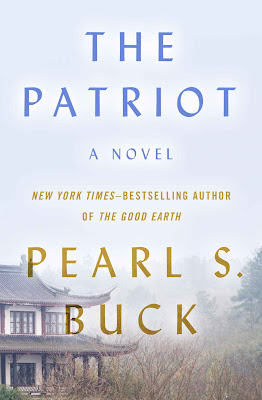
Buck, Pearl S. "The Patriot"

1939


Reviewed by Marianne
from Let's Read


Pearl S. Buck was always a great writer of historical fiction. Here, she talks about the problems between China and Japan during Chiang Kai-Chek's time and the Sino-Japanese war.

A mixed marriage brings two families together, and nobody can tell the story of two cultures clashing better than the Nobel Prize winning author.

The history intermingles with the lives of the protagonists - it would, of course, and we can see how politics influence the family and how their reactions influence their lives.

As all books by Pearl S. Buck, a great tale of different cultures.

From the back cover:

"A Chinese dissident is torn between love and country in this novel from the New York Times–bestselling author of The Good Earth.

When Wu I-wan starts taking an interest in revolution, trouble follows: Winding up in prison, he becomes friends with fellow dissident En-lan. Later, his name is put on a death list and he’s shipped off to Japan. Thankfully, his father, a wealthy Shanghai banker, has made arrangements for his exile, putting him in touch with a business associate named Mr. Muraki. Absorbed in his new life, I-wan falls in love with Mr. Muraki’s daughter, and must prove he is worthy of her hand. As news spreads of what the Japanese army is doing back in China, I-wan realizes he must go back and fight for the country that banished him.
"

Pearl S. Buck received the Nobel Prize for Literature in 1938 "for her rich and truly epic descriptions of peasant life in China and for her biographical masterpieces".

Read my other reviews of the Nobel Prize winners for Literature.  

Original Post on "Let's Read".

Buck, Pearl S. "The First Wife and Other Stories"

1933


Reviewed by Marianne
from Let's Read


Some wonderfully described stories about Chinese life up until the beginning of the 20th century. The author talks about the clash between the traditional Chinese and the Western way, something she must have experienced herself as the daughter of a US missionary in China. The title story talks about a guy who goes abroad and doesn't really relate to his coutry wife anymore so that he divorces her and takes a new one, something that would not have happened before.

But there are also other subjects in the various other stories, some talk about the revolution and what was going on at that time, the devastations after a great flood, daily life in China at the time.

This is a great book to see what changes in tradition and life can do to people. Not just in China. If I compare my chidlren's life with that of my grandparents, there is a huge difference and I don't think my grandparents would have understood any of it. Pearl S. Buck saw this when living in China, she saw how people struggled with the newness of everything adn how a lot of them couldn't cope with it.

A nice collection of stories.

Contents:
Old and new:
  • The first wife
  • The old mother
  • The frill
  • The quarrel
  • Repatriated
  • The rainy day
Revolution:
  • Wang Lung
  • The communist
  • Father Andrea
  • The new road
Flood
  • Barren spring
  • The refugees
  • Fathers and mothers
  • The good river 

Pearl S. Buck received the Nobel Prize for Literature in 1938 "for her rich and truly epic descriptions of peasant life in China and for her biographical masterpieces" and the Pulitzer Prize for "The Good Earth" in 1932.


Read my other reviews of the Nobel Prize winners for Literature.  

Original Post on "Let's Read".

Buck, Pearl S. "The Mother"

1933


Reviewed by Marianne
from Let's Read


I have been reading Pearl S. Buck novels ever since I was a teenager, so about 40 years now. But there are still so many of her books I haven't read.

I came across this little gem in a used bookshop.

As it happens so often in her books, the author does not reveal the names of the children as this seems to have been quite normal in China. But in this case, there isn't even another name involved. The only one we come across, "the mother" is sometimes called Mrs. Lee.

However, the names don't matter. We get to know a poor peasant woman and her family, her thoughts and her feelings, her hardships, how she leads her life, how she is forced to look after her family, how all her life is just work and responsibility.

I have seldom read a book that goes so deep into the heart of the protagonist. We get to know the traditions in a little village in China, the way girls are married off into another family.

If you want to learn about pre-revolutionary rural China, this is the right book. If you want to read more books by Pearl S. Buck, check all my posts about her here. I suggest you start with "The Good Earth".

From the back cover:

"Within this novel Ms. Buck paints the portrait of a poor woman living in a remote village whose joys are few and hardships are many. As the ancient traditions, which she bases her philosophies upon, begin to collide with the new ideals of the communist era, this peasant woman must find a balance between them and deal with the consequences."

Pearl S. Buck received the Nobel Prize for Literature in 1938 "for her rich and truly epic descriptions of peasant life in China and for her biographical masterpieces" and the Pulitzer Prize for "The Good Earth" in 1932.


Read my other reviews of the Nobel Prize winners for Literature.  

Original Post on "Let's Read".

Buck, Pearl S. "Sons"

1932

Reviewed by Marianne
from Let's Read


The second volume in the "Good Earth Trilogy", this book focuses on Wang Lung's sons and how life goes on after his death. Again, Pearl S. Buck manages to describe everyone's life in so much detail.

I didn't like the characters as much as the ones in "The Good Earth" but I thought the actions were very interesting and exciting. You can tell how China got closer to the revolution. You can also tell why they had a revolution and how history evolved from there.

Great book. I'm still looking for the third volume "A House Divided" which is out of print.


From the back cover:

"Second in the trilogy that began with The Good Earth, Buck's classic and starkly real tale of sons rising against their honored fathers tells of the bitter struggle to the death between the old and the new in China. Revolutions sweep the vast nation, leaving destruction and death in their wake, yet also promising emancipation to China's oppressed millions who are groping for a way to survive in a modern age."

Find other books by Pearl S. Book that I read here.

Pearl S. Buck received the Nobel Prize for Literature in 1938 "for her rich and truly epic descriptions of peasant life in China and for her biographical masterpieces"


Read my other reviews of the Nobel Prize winners for Literature.  

Original Post on "Let's Read".

Buck, Pearl S. "Imperial Woman"

1956

Reviewed by Marianne
from Let's Read


A mixture between fiction and non-fiction, a biography but also a novel. Tzu Hsi, the last Empress in China. Her life and her death.

Pearl S. Buck manages, as always, to describe the life of this extraordinary city in a gripping way. A fascinating description of a world long gone, the way people lived in the Far East.

It is difficult to understand in our modern world how families could send their daughters to become a concubine of any man, even if he was to become the emperor of a vast dynasty.

I really love this book that resonates with me even years after I read it the last time.

From the back cover:

"Imperial Woman is the fictionalized biography of the last Empress in China, Ci-xi, who began as a concubine of the Xianfeng Emperor and on his death became the de facto head of the Qing Dynasty until her death in 1908.Buck recreates the life of one of the most intriguing rulers during a time of intense turbulence.Tzu Hsi was born into one of the lowly ranks of the Imperial dynasty. According to custom, she moved to the Forbidden City at the age of seventeen to become one of hundreds of concubines. But her singular beauty and powers of manipulation quickly moved her into the position of Second Consort.Tzu Hsi was feared and hated by many in the court, but adored by the people. The Empress's rise to power (even during her husband's life) parallels the story of China's transition from the ancient to the modern way."

Find other books by Pearl S. Book that I read here.

Pearl S. Buck received the Nobel Prize for Literature in 1938 "for her rich and truly epic descriptions of peasant life in China and for her biographical masterpieces".


Read my other reviews of the Nobel Prize winners for Literature.  

Original Post on "Let's Read".

The Good Earth by Pearl S. Buck


1931

Reviewed by Marianne
from Let's Read 

The first volume in the "Good Earth Trilogy", the second one is "Sons", the third "A House Divided".

I absolutely love this book. Pearl S. Buck was my first "grown up" author, I read all the books our little village library had.

The description of all sorts of people in pre-revolutionary China is really interesting, Pearl S. Buck manages to describe every single person and event so vividly, you feel like you're almost there.

We lead a very different life today and I'm grateful for that. It was a hard life back then, especially for women who were considered a burden to their families and often sold when they didn't have enough money.

Wang Lung, the protagonist of the story, manages to get very rich through the land he buys. He owes all this to his wife who used to be a slave. But he doesn't really recognize this and leads a life any male would lead at the time. I cannot really judge him for that because he didn't know any better. I feel sorry for his wife, O-Lan, though for whom life was one big misery.

From the back cover: "This Pulitzer Prize-winning classic tells the poignant tale of a Chinese farmer and his family in old agrarian China. The humble Wang Lung glories in the soil he works, nurturing the land as it nurtures him and his family. Nearby, the nobles of the House of Hwang consider themselves above the land and its workers; but they will soon meet their own downfall.

Hard times come upon Wang Lung and his family when flood and drought force them to seek work in the city. The working people riot, breaking into the homes of the rich and forcing them to flee. When Wang Lung shows mercy to one noble and is rewarded, he begins to rise in the world, even as the House of Hwang falls.
"

Find other books by Pearl S. Book that I read here.

Pearl S. Buck received the Nobel Prize for Literature in 1938 "for her rich and truly epic descriptions of peasant life in China and for her biographical masterpieces" and the Pulitzer Prize for "The Good Earth" in 1932. 

Read my other reviews of the Nobel Prize winners for Literature.  

Original Post on "Let's Read".

The Living Reed by Pearl S. Buck

http://www.amazon.co.uk/gp/product/1559210222/ref=as_li_qf_sp_asin_il_tl?ie=UTF8&camp=1634&creative=6738&creativeASIN=1559210222&linkCode=as2&tag=editsmisc00-21
Reviewed by Edith LaGraziana

With today’s review I’m moving from Israel on the western coast of Asia to the south-eastern edge of the continent, namely to the Korean peninsula. Keeping largely to herself the Kingdom of Korea managed to ward off territorial cravings of Russia, China and Japan for centuries, but modern times introduced Europe and the United States of America into the game. Power shifted continually towards the Japanese Empire and in the early twentieth century Korea was first occupied by and then annexed to her. The Living Reed by Nobel laureate Pearl S. Buck tells he fictitious story of four generations of a Korean noble family working for their country’s independence. 

Pearl S. Buck, also known under her Chinese name 賽珍珠, was born as Pearl Comfort Sydenstricker in Hillsboro, West Virginia, USA, in June 1892. Her parents being Presbyterian missionaries in China she grew up in Zhenjiang near Nanking. After college in the USA she returned to China and married the agricultural economist missionary John Lossing Buck. As from 1927 Pearl S. Buck devoted herself to writing and brought out her first novel titled East Wind: West Wind in 1930 which was immediately followed by The House of Earth trilogy (The Good Earth: 1931; Sons: 1933; A House Divided: 1935). In 1935 she got divorced and married her editor Richard Walsh with whom she had been involved since 1930. “For her rich and truly epic descriptions of peasant life in China and for her biographical masterpieces” Pearl S. Buck received the 1938 Nobel Prize in Literature. Other notable works of the prolific writer of fiction as well as non-fiction are for instance Dragon Seed (1942), The Promise (1943), The Big Wave (1948), Peony (1948), and The Living Reed (1963). Pearl S. Buck kept writing until her death from lung cancer in Danby, Vermont, USA, in March 1973.

The subtitle of The Living Reed immediately identifies the book as a novel of Korea. To be precise it’s a historical novel showing the country’s striving for independence between 1881 and 1945 at the example of the Kim family of the clan of Andong who are rich scholars belonging to the highest nobility of Korea and having a long tradition in the royal service. The story begins in Seoul in spring 1881, when a second son is born to Il-han and his wife Sunia. Meanwhile the older son got angry and broke several young shoots in the bamboo grove in the garden and Il-han explains to him that
“…, they grow only once from the root. The plants these shoots might have been, waving their delicate leaves in the winds of summer, will never live. The shoots crack the earth in spring, they grow quickly and in a year they have finished their growth. You have destroyed food, you have destroyed life. Though it is only a hollow reed, it is a living reed. Now the roots must send up other shoots to take the place of those you have destroyed. …” 
It’s a crucial moment in Korean history because the country is torn between those who like King Kojong and Il-han believe that only opening up to the world, especially to the United States of America, can save the millennia old Kingdom from annexation and those who like Queen Min and Il-han’s father trust in the traditional policy of seclusion under the suzerainty (and protection) of the Chinese Empire. Although neither Il-han nor his father holds an official position at the Royal Court, they are both loyal advisers to the Royal Couple. However, unrest is growing among Koreans and Il-han sets out to travel the whole country to get to know his own people. On his return home Il-han finds Queen Min in his house. She is hiding from the bloodhounds of the former Regent, who meanwhile seized power, and he saves her as is his duty. Some months after her and her husband’s restoration to the throne, Il-han and others are sent to the USA and Europe to learn more about those countries. After the experience Il-han is more than ever convinced that Korea needs the USA on her side and accordingly advises King Kojong. A treaty with the USA is made and first steps towards the modernisation of the country are initiated, but old and new political as well as social tensions are steadily growing over the years. Rebel groups like the Tonghak are attracting members everywhere and as it turns out Il-han’s elder son Yul-chun, who is now a young man attending a foreign school in Seoul, belongs to it. At the same time China, Russia and Japan are heading into war and the independence of Korea is threatened, but the USA don’t intervene as their treaty with Korea proclaims, not even when Japanese troupes enter the country and kill Queen Min. While Il-han’s younger son adapts to the Japanese regime, his elder son fights it and disappears for a long time while a rebel called “The Living Reed” enters the scene. 

The whole story of The Living Reed is told by a third-person narrator, but Pearl S. Buck decided to add a first-person epilogue to explain what inspired her to write the novel and above all to provide a link between the plot that ends with the arrival of US-American troupes in Seoul in 1945 and the independent, though divided Korea of the early 1960s. For a better understanding of Korean history the author also wrote a historical note as an introduction which is quite interesting although I doubt that it made the story any more accessible than it would have been without it. The first part covering the period between spring 1881 and Korea’s annexation to the Japanese Empire in 1910 takes up almost half of the books and is told in great detail, while the following two parts dedicated to the periods between 1910 and the suppression of the Mansei Demonstration in 1919 and the years from 1919 to 1945 are much shorter and seem too cursory by comparison. As regards the descriptions of life in exile and under Japanese rule, I also suspect that they might not be very realistic because they feel strangely light and uncomplicated. An important focus of the entire novel is on change, namely on the individual as well as on the political and social level. Characters are modelled with great skill and narrative foresight although the special traits of Il-han’s grandsons make expect much more of them than the plot offers because the author opted for a rather sudden – and in my opinion unsatisfactory – ending. To tell the story of the Kims and Korea Pearl S. Buck used simple language which is at the same time poetic and sometimes imitating traditional Korean ways of narration. 

All in all I enjoyed reading The Living Reed by Pearl S. Buck and plunging into a world that is so far from my own experience and into aspects of history which have been known to me only rudimentary because they are too loosely connected to what happened in Europe at the time to be taught in our schools. It’s certainly a book that helps to raise cultural awareness and understanding for the historical as well as ideological background of the lasting division of the peninsula into a secluded Communist North and open democratic South Korea. Therefore I believe that it deserves to be read by many more people than it is today.

Original post on Edith's Miscellany:

Pavilion of Women by Pearl S. Buck

1946

Reviewed by Marianne from "Let's Read"

I have always loved the books by Pearl S. Buck. She writes about a world that is so different from the one I know. And every single one of her stories is telling us a new aspect of that life. In this case, rich Madame Wu who lives in pre-communist China. On her 40th birthday, she decides that she wants to retire from her conjugal duties and informs her husband that she will bring in a young second wife and changes her whole life. Her family is absolutely horrified but she carries on with her own life, she starts reading and then goes on to study, something women at that time in China didn't do.

Her books captivate me every time. They raise so many subjects, often about women but also about freedom and justice. I love them. If I've had the misfortune to choose a few books in a row that I didn't like very much, Pearl S. Buck is always a safe bet to get me back to good reading.

From the back cover: "On her fortieth birthday, Madame Wu carries out a decision she has been planning for a long time: she tells her husband that after twenty-four years their physical life together is now over and she wishes him to take a second wife. The House of Wu, one of the oldest and most revered in China, is thrown into an uproar by her decision, but Madame Wu will not be dissuaded and arranges for a young country girl to come take her place in bed. Elegant and detached, Madame Wu orchestrates this change as she manages everything in the extended household of more than sixty relatives and servants. Alone in her own quarters, she relishes her freedom and reads books she has never been allowed to touch. When her son begins English lessons, she listens, and is soon learning from the "foreigner," a free-thinking priest named Brother Andre, who will change her life. Few books raise so many questions about the nature and roles of men and women, about self-discipline and happiness."

Pearl S. Buck received the Nobel Prize for Literature in 1938 "for her rich and truly epic descriptions of peasant life in China and for her biographical masterpieces".

Read my other reviews of the Nobel Prize winners for Literature

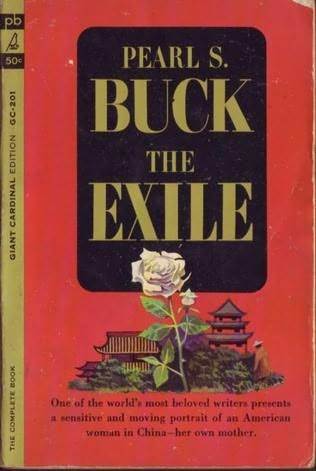
The Exile by Pearl S. Buck

1936

Reviewed by Marianne from "Let's Read"

Pearl S. Buck grew up mostly in China, the daughter of American missionaries. In her many novels she describes the life of Chinese people past and present.

This book, however, is a biography about her mother, Carie Stulting Sydenstricker, a missionary and the wife of a missionary, who led most of her adult life in a foreign place, who went through hard times both politically as well as personally. She lived through several invasions, the Japanese, the Russians, through illnesses and death of her children. She lives in two worlds and cannot claim either of them as her real home in the end.

Same as her novels, I really loved this biography of the author's mother. She shows how much love can change life of the people around you and sometimes of a lot more.

From the back cover: "The biography of the mother of Pearl S. Buck, a portrait of an American woman in China."
 
Pearl S. Buck received the Nobel Prize for Literature in 1938 "for her rich and truly epic descriptions of peasant life in China and for her biographical masterpieces".

Read my other reviews of the Nobel Prize winners for Literature.

East Wind: West Wind by Pearl S. Buck

1930


Reviewed by Marianne from "Let's Read"


This was one of my first Pearl S. Buck novels. I came to adore her, read a lot of her books during my teenage years, probably because they were easy to read, yet so informative. I still love them and still read a book of hers from time to time.

I love the way Pearl S. Buck can explain the life in China, life in China during her lifetime, of course, I am well aware that it has changed a lot again. She has a wonderful way of explaining the Chinese way, almost in parables.

But this is history, life in Asia seen through the eyes of an American. The title already tells us about the divide between the East and the West, how people believe that they cannot be mixed. For example, the protagonist of the story, Kwei-Li, lives in a modern style house and is amazed by a lot of the features. Her brother brings home an American wife who is not accepted by the family. Lots of explanations about the different kind of life in the two different continents. This book achieves to portray this so wonderfully.

The biggest subject of the novel is the custom of arranging marriages. Kwei-Lan is married to a doctor, an educated man, who starts caring for her when she asks him to unbind her feet. Her brother refuses to marry the wife his parents have chosen for him and gets disinherited. A subject, most of us in the modern West are completely unaccustomed to.

Certainly one of Pearl S. Buck's books where we see the difference between our lives and that of the ancient Chinese most, where she serves it to us on a silver platter. I would probably recommend anyone to start with this book if they haven't read one by this great author.

From the back cover: "'East Wind: West Wind' is told from the eyes of a traditional Chinese girl, Kwei-lan, married to a Chinese medical doctor, educated abroad. The story follows Kwei-lan as she begins to accept different points of view from the western world, and re-discovers her sense of self through this coming-of-age narrative."

Pearl S. Buck received the Nobel Prize for Literature in 1938 "for her rich and truly epic descriptions of peasant life in China and for her biographical masterpieces".

Read my other reviews of the Nobel Prize winners for Literature.

Peony by Pearl S. Buck

1948

Reviewed by Marianne from "Let's Read"

This book is the reason I fell in love with Pearl S. Buck. It must have been one of the first "adult" books I read and still, I remember it as if it had been yesterday.

Peony is a young servant (almost a slave) in a rich Chinese Jewish household. Her love to the son of the family cannot result in anything as traditional rules don't allow a marriage between them.

While we learn about Chinese traditions, the author also tells us about the life of the Kaifeng Jews of which I had nothing heard before (or after). We can again dive into the sea of knowledge Pearl S. Buck acquired about Chinese life when she spent most of her life there, starting when her missionary parents took her there at a very young age. I have loved reading about China ever since, both historical and present day novels as well as non-fiction. I would love to visit this highly interesting country one day.

However, other than a lot of her other novels, she tries to incorporate the multi-cultural theme into this one, the trial of assimilation. How far does an immigrant want to become like the people in his host nation. A wonderful account of two worlds colliding.

From the back cover:
"In 1850s China, a young girl, Peony, is sold to work as a bondmaid for a rich Jewish family in Kaifeng. Jews have lived for centuries in this region of the country, but by the mid-nineteenth century, assimilation has begun taking its toll on their small enclave. When Peony and the family’s son, David, grow up and fall in love with one another, they face strong opposition from every side. Tradition forbids the marriage, and the family already has a rabbi’s daughter in mind for David. 

Long celebrated for its subtle and even-handed treatment of colliding traditions, Peony is an engaging coming-of-age story about love, identity, and the tragedy and beauty found at the intersection of two disparate cultures.
"

Pearl S. Buck received the Nobel Prize for Literature in 1938 "for her rich and truly epic descriptions of peasant life in China and for her biographical masterpieces".

Read my other reviews of the Nobel Prize winners for Literature.

The Good Earth by Pearl S. Buck - Laura's Review

The Good Earth
Pearl S. Buck
260 pages

Pearl Buck's classic novel is an epic portrayal of agrarian China near the turn of the twentieth century, leading up to the 1912 Revolution. The novel opens on the wedding day of Wang Lung, a poor farmer. His wife, O-lan, has spent her youth as a slave for a wealthy family in town. Up to this time, Wang Lung has had to care for his father in addition to farming the land, and he is simply glad to have someone to cook, clean, and tend to his father while he works the land. His relationship with O-lan develops, in a traditional way, as she bears him children and works with him in the fields. During a time of widespread crop failure, they migrate to a southern city and learn to survive in far different conditions. But the pull of the land is strong, and eventually Wang Lung and his family return to their home town and prosper as farmers and landowners.

Over the years the family experiences birth, death, marriage, and war; happiness as well as suffering. Buck brings the characters of Wang Lung, O-lan, and their children to life. Wang Lung could be rather distasteful by modern, western standards, even when he was simply trying to provide the best for his family. At other times, he was motivated by selfish desires and made decisions which would be harmful viewed through any cultural lens. And I felt sorry for O-lan, who was helpless under his partriarchal rule.

Towards the end of The Good Earth, Wang Lung prepares to pass his land to his sons, just as China is preparing to pass over into a new era of its own. My edition of this book included a reader's supplement with cultural notes and photos of weddings, markets, and ordinary people which helped bring the story and the time period to life. This book is more than just an epic family saga, it also paints a fascinating picture of the life and customs of a country on the brink of dramatic change. ( )

My original review can be found here.

The Good Earth by Pearl S. Buck

Pearl S. Buck's classic story of family and life in pre-revolutionary China. This did not take as long as I thought, and while sad at times, I liked the book. I think the prose is distinct, the story compelling and honest, and the characters very real. I liked the themes of the novel which explored man's relation to the earth, changing fortunes, China at the turn of the century, and women's role in society and family. She writes everything so deftly and without judgment; a very true story teller. I am very familiar with Chinese culture, family, and livelihood. Buck said she wrote about China because it was all she knew. She might have been a foreigner, but there is such an candid and wonderful perspective in her writing. Dare I say it, but this book is very Chinese. It is difficult to describe how she captured the Chinese characters and cultural identity so well. Once again, I found so much honesty in her writing. I liked how she painted the picture of O-Lan and the other women in Chinese society. While I appreciated the writing and the book, I do not think I will continue with the trilogy because I am not particularly attached to the characters beyond this book, and the stories can be rather sad. I would be interested in reading more of Buck's other stories.

Crossposted from aquatique.net.
·
OLDER


© Read the NobelsMaira Gall