2003: J.M. Coetzee
Showing posts with label 2003: J.M. Coetzee. Show all posts

Foe (1986), by J M. Coetzee


When I set aside J M Coetzee's Foe for Novellas in November, I had completely forgotten that I'd read it before.  Indeed, I had even posted at Goodreads an embarrassed 'review' from my 2002 reading journal that seemed like the thoughts of a stranger, not of my own mind.

I feel that my rating is wrong... the fact that I didn't understand it at that long ago time in my reading journey means that it's not the book that should be rated, it's me. The reader who read it 15 years ago is not the same reader as the reader now, and I bet if I read it again now after many years of reading and enjoying postmodern novels, I'd rate it very differently.

Twenty years later, here we are, and I certainly have changed my rating.  I rarely rate books with five stars, but Foe is brilliant.

By the time I got to Part III of this cunning little book, increasingly I was finding myself amused.  Mr Foe, seeking to reassure (or maybe to dupe) Susan Barton who is beginning to doubt her own existence, says to her:

'But if you cannot rid yourself of your doubts, I have something to say that may be of comfort.  Let us confront our worst fear, which is that we have all of us been called into the world from a different order (which we have now forgotten) by a conjuror unknown to us, as you say I have conjured up your daughter and her companion (I have not).  Then I ask nevertheless: Have we thereby lost our freedom? Are you, for one, any less mistress of your life?  Do we of necessity become puppets in a story whose end is invisible to us, and towards which we are marched like condemned felons? You and I know, in our different way, how rambling an occupation writing is; and conjuring is surely much the same. (p.135)

Ha!

Part I begins with Susan Barton's narrative about her experience as a castaway, which we learn later has been written in an attempt to make some much needed money.  Washed up on an island where she finds Cruso and Friday, whose names of course are those we know from our childhood reading of Daniel Defoe's Robinson Crusoe.  She was on her way home to Britain after a fruitless search in the New World for her unnamed daughter who was abducted by a trader.  En route to Lisbon the crew mutinied, 'insulted' her and then cast her adrift with the dead Captain.

(Her use of the term 'New World' and the euphemistic 'insulted' gives the reader an indication of the era in which this tale is taking place. And Coetzee's dialogue is flawless.)

Playing with the reader, Coetzee begins her description of the desert island with a nod to Daniel Defoe:

'For readers reared on travellers' tales, the words desert isle may conjure up a place of soft sands and shady trees where brooks run to quench the castaway's thirst and ripe fruit falls into his hand, where no more is asked of him than to drowse the days away till a ship calls to fetch him home. (p.7) 

Debunking the idea of a lush paradise, her desert island lacks the ingenious contrivances fashioned by Robinson Crusoe because her Cruso has salvaged only a knife and after many years on the island has used it only to make a rudimentary shelter.  Their diet is monotonous because there are no plants that can be cultivated for food, there are no fauna suited to animal husbandry, and there are no fruits falling from the trees or otherwise. They live on a kind of weed, and fish, caught by Friday.

Worse than that is that Cruso has no initiative.  He resists all Susan's efforts to encourage improvements in their tedious life, and continues building useless terraces for plants that can't be cultivated in them.  He has lapsed into inertia and a morose listlessness, unable and unwilling to talk, to share his personal history, or to offer any consolation.

The slave Friday is mute, because his tongue has been cut out.  He follows orders, but there isn't much for him to do.  He has a kind of dignity that the others lack...

BEWARE: SPOILERS

Well, time passes and they are rescued.  Cruso dies en voyage and is buried at sea.  Penniless and responsible for Friday whose prospects in Britain are bleak, Susan makes contact with a writer called Foe (Defoe, sans 'de') so that he can render her narrative publishable.   They both agree that it is a bit dull, and needs to be livened up a bit. But how?

Part II is epistolary, consisting of increasingly frantic letters to Defoe, who neglects to reply and then disappears because of the bailiffs arriving at his home. This one-sided correspondence reveals that the public appetite for castaway literature craves more drama, exoticism, heroic characters with ingenuity and stoicism than the truth of her experience can provide. Foe wants to turn it into a salacious bestseller with cannibals, mysterious footprints in the sand and evidence of English ingenuity in the form of fine craftmanship and inventiveness in the castaway's adaptations to life on the island.  Foe's castaway, recognisable to anyone who read Robinson Crusoe, would never cease to be 'civilised' and of course would always want to return to civilisation.

Resistant to the warped story emerging from her experience, Susan Barton is further discombobulated by the arrival of a young women purporting to be her daughter.  Also called Susan Barton, this young woman knows things about the island that only Foe could have told her.

In Part III, Coetzee becomes more playful.  Sarah, who is 'real' (if anyone in this story is 'real') is being written out of her own story and Defoe's Crusoe will emerge into literary history without her.  Part IV consists of drafts of Sarah's narrative, found by a visitor to Daniel Defoe's house, now identified by a plaque bolted to the wall.  Daniel Defoe, Author, are the words, white on blue.  The identity of this visitor mystified me, but I have been enlightened by no less than the author himself.  According to Wikipedia's page for Foe, Coetzee in his Nobel Prize acceptance speech, identified this visitor as an elderly Crusoe quietly living in Bristol [who] becomes the ambivalent muse of Defoe. (Coetzee also said that he identified with Sarah as the 'unsuccessful writer.')

There are all sorts of metaphors in Foe: the obliteration of women in history, of Black History, and of land appropriation (Cruso assumes ownership of the island, and his terraces are monuments to himself.)  The novella speaks to the pervasiveness of Othering, and for salacious reporting in the media at the expense of truth.  Perhaps more contentious is the role and characterisation of Friday in the story.  For me, he represents the irreparable damage done by slavery and colonisation.  Though Friday is said to desire freedom, how can he have it? Well-intentioned attempts to communicate with him, through music, art, or teaching him to write, have failed, but he is never treated as an equal, sleeping on the floor and fed last when there are not enough plates to go round. He no longer belongs anywhere, he can't articulate where his home might be, and he has no means of making an independent living.  In Britain, he is always at risk of being accepted as a passenger to the New World but offloaded by unscrupulous traders at a slave port instead. He is a symbol of colonialism, which exploits all that is valuable, leaving insurmountable challenges when freedom is finally achieved.

Coetzee was awarded the Nobel Prize for Literature in 2003.  His citation states that Coetzee "in innumerable guises portrays the surprising involvement of the outsider."

Author: J.M. Coetzee
Title: Foe
Cover art by Paul Buckley, Cover painting by John Collier
Publisher: Penguin Books, 1987, first published 1986
ISBN: 9780140096231, pbk., 157 pages
Source: personal library 
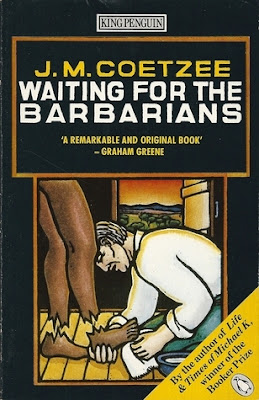
Coetzee, J.M. "Waiting for the Barbarians"

1980


Reviewed by Marianne
from Let's Read


No names or places are mentioned in this novel. So, the story could take place in any corrupt country, in any dictatorship. Since the author is South African, I suppose that's where it takes place.

The description of the protagonist, the magistrate in a small post on the border of "the Empire" is very good. We see how he goes from thinking he is a loyal servant of a fair government to the discovery that the so-called barbarians are oppressed by the regime and those who think they are better than others for whatever reason.

As with so many novels that tell us about these situations, it is quite frightening to think how it is living in such a situation, where already your thoughts are a sin and nobody is supposed to know about it. And beware of helping others, especially if they are on the list of "enemies", "terrorists", "barbarians", whatever they are called in the respective countries.

This book might be more than fifty years old, but it's still as contemporary as ever. I can think of a few countries that are still in a similar situation, and I bet you can, as well.

We read this in our international online book club in January 2023.

Comments by other members:

I thought a lot about the namelessness of them/it all. I found it brutal, and abit difficult to read, as there was so much content in every word. I was not at all fond of the main character either, for being quite self-centered and lazy, (and a bit whiny) thinking one right corrects all wrongs and times he was the enabler.

I was left with questions such as "Why must empires expand?" "Why do empires such as this one pave the way for cruel and ambitious people into places of leadership?" "Where does suspicion come from?" I mean, attack first or else "the others" will attack us" or "cause pain to gain the real truth" or is it a calculated power-move, propaganda, guiding the narrative of the empire to keep expanding and keeping power central. "Who were really the barbarians?".

I enjoyed our discussion about the book a lot.

From the back cover:

"For decades the Magistrate has been a loyal servant of the Empire, running the affairs of a tiny frontier settlement and ignoring the impending war with the barbarians. When interrogation experts arrive, however, he witnesses the Empire's cruel and unjust treatment of prisoners of war. Jolted into sympathy for their victims, he commits a quixotic act of rebellion that brands him an enemy of the state. J. M. Coetzee's prize-winning novel is a startling allegory of the war between opressor and opressed. The Magistrate is not simply a man living through a crisis of conscience in an obscure place in remote times; his situation is that of all men living in unbearable complicity with regimes that ignore justice and decency."

J.M. Coetzee "who in innumerable guises portrays the surprising involvement of the outsider" received the Nobel Prize in 2003 and the Booker Prize for this novel in 1999.

Read my other reviews of the Nobel Prize winners for Literature.  

Original Post on "Let's Read".

Coetzee, J.M. "Disgrace"

1999


Reviewed by Marianne
from Let's Read


I have read the book quite a while ago and really liked it. I was going to read more by this author but with my long TBR pile ...

Anyway, I liked the description of the people, the professor who, after having lost his job, goes to live with his daughter, Lucy, in a remote area in South Africa. I really liked Lucy, too, the description of South Africa, both the landscape and the life/political situation. I could imagine being there, that's always a good book for me. And it's quite different from my life, so it's definitely interesting. 

From the back cover:

"After years teaching Romantic poetry at the Technical University of Cape Town, David Lurie, middle-aged and twice divorced, has an impulsive affair with a student. The affair sours; he is denounced and summoned before a committee of inquiry. Willing to admit his guilt, but refusing to yield to pressure to repent publicly, he resigns and retreats to his daughter Lucy's isolated smallholding.

For a time, his daughter's influence and the natural rhythms of the farm promise to harmonise his discordant life. But the balance of power in the country is shifting. He and Lucy become victims of a savage and disturbing attack which brings into relief all the faultlines in their relationship.
"

J.M. Coetzee "who in innumerable guises portrays the surprising involvement of the outsider" received the Nobel Prize in 2003 and the Booker Prize for this novel in 1999.


Read my other reviews of the Nobel Prize winners for Literature.  

Original Post on "Let's Read".

Coetzee, J.M. "The Master of Petersburg"


- 1994

Reviewed by Marianne


I love Russian authors and I love Nobel Prize winners, so this was a win-win situation. A book by a Nobel Prize winning author writing about the life of a Russian author must be good, right?

It was but it was a hard read, despite it being just around 250 pages. You had to constantly remind yourself that this is a work of fiction even though a lot of the events are taken from real life. You do recognize the author Dostoevsky here and all his struggles with life, you do see parts of Russia's problems during that time, some real-life people. So, you either don't know anything about Dostoevsky and just accept this as a story or you have to constantly forget that this isn't non-fiction.

However, Dostoevsky was wonderfully portrayed, it was a great book about Russia, the book received several international prizes, i.a. the Commonwealth Writers' Prize.

From the back cover:

"Winner of The Nobel Prize For Literature 2003

In The Master of Petersburg J. M. Coetzee dares to imagine the life of Dostoevsky. Set in 1869, when Dostoevsky was summoned from Germany to St Petersburg by the sudden death of his stepson, this novel is at once a compelling mystery steeped in the atmosphere of pre-revolutionary Russia and a brilliant and courageous meditation on authority and rebellion, art and imagination. Dostoevsky is seen obsessively following his stepson's ghost, trying to ascertain whether he was a suicide or a murder victim and whether he loved or despised his stepfather."

J.M. Coetzee "who in innumerable guises portrays the surprising involvement of the outsider" received the Nobel Prize in 2003 and the Booker Prize for this novel in 1999.


Read my other reviews of the Nobel Prize winners for Literature.  

Original Post on "Let's Read".

Coetzee, J.M. "The Childhood of Jesus"

2013


Reviewed by Marianne
from Let's Read


I don't really know what to say about this book. It is so strange. A man and a boy arrive in a new country. We are supposed to believe, I think, that they are refugees abut we have no idea from where they come and where they went, only that they had to cross an ocean. They could have gone from Africa to South America, Asia to Australia, North America to Europe or any combination thereof. The only continent I wouldn't suspect is Antarctica though it could be after climate change has taken place and they start settling people there.

That doesn't really matter. I'm not even sure whether this is supposed to be a dystopian novel or not, though I will call it that. Everyone in this country starts with a clean slate, they are given a new name, their past is forgotten. Sounds more like a utopian tale at the beginning, however, it's not. Life couldn't be made more difficult for new arrivals.

I have come to really dislike the boy and that is something I don't really like. I remember a member of our book club mention that she hated books where the children are so awful that one can only dislike them. I doubt she would have liked this book.

As to the title, I have no idea what the title has to do with the novel. There are biblical allusions but without the name "Jesus", it might as well have been coincidences.

Somewhere on the internet I read someone recommending "Disgrace" and "Life of Times of Michael K." and avoid this one. I wish I had read that before starting this novel. I did enjoy "Disgrace" a lot more than this one.

From the back cover:

"After crossing oceans, a man and a boy arrive in a new land. Here they are each assigned a name and an age, and held in a camp in the desert while they learn Spanish, the language of their new country. As Simón and David they make their way to the relocation centre in the city of Novilla, where officialdom treats them politely but not necessarily helpfully.

Simón finds a job in a grain wharf. The work is unfamiliar and backbreaking, but he soon warms to his stevedore comrades, who during breaks conduct philosophical dialogues on the dignity of labour, and generally take him to their hearts.

Now he must set about his task of locating the boy’s mother. Though like everyone else who arrives in this new country he seems to be washed clean of all traces of memory, he is convinced he will know her when he sees her. And indeed, while walking with the boy in the countryside Simón catches sight of a woman he is certain is the mother, and persuades her to assume the role.

David's new mother comes to realise that he is an exceptional child, a bright, dreamy boy with highly unusual ideas about the world. But the school authorities detect a rebellious streak in him and insist he be sent to a special school far away. His mother refuses to yield him up, and it is Simón who must drive the car as the trio flees across the mountains.

THE CHILDHOOD OF JESUS is a profound, beautiful and continually surprising novel from a very great writer."

J.M. Coetzee "who in innumerable guises portrays the surprising involvement of the outsider" received the Nobel Prize in 2003.

Read my other reviews of the Nobel Prize winners for Literature.  

Original Post on "Let's Read".

Youth by John Maxwell Coetzee


Originally reviewed by Edith LaGraziana
on Edith's Miscellany

At one point or another in life many people feel the urge to write the memoirs of their young years and to share them with others, be it only the family, be it the whole world if they can find a publisher. Writers seem even more inclined to reminisce and portray themselves. In the autobiographical novel Youth by J. M. Coetzee, the recipient of the Nobel Prize in Literature of 2003 takes on the role of his own biographer. Almost like a stranger he looks back on the late 1950s and early 1960s, when he was just a young man aspiring to be a writer one day. He knows that in the initial stage he won’t be able to earn his livelihood writing and so after graduation from university in Cape Town he becomes a computer programmer in London. His first job depresses him, but the second one stimulates him.

Dusklands by J.M. Coetzee


Dusklands by J.M. Coetzee, reviewed by Lisbeth Ekelof at The Content Reader.

Dusklands contains two separate stories, seen from a male point of view. In both stories there is a person called Coetzee; one tyrannic boss (at least seen from Eugene Dawns perspective) in the first story and a tyrannic land owner in South Africa in the 1760s in the latter part. The method to use the name of the writer in the stories, makes us believe that what is told has actually happened. One could say that it gives a sort of authenticity to the stories. The prologue, in both stories, indicates that what we are about to read, has already happened. Both stories are told from first-person singular, presens. Both stories highlights and indicates, via descriptions and figuration, the times they are portraying.

The Vietnam Project

In the first story we meet Eugene Dawn, who works for a man named Coetzee on a project that aims to find a way to win the war via mythological ideas about the enemy. The story indicates that we are at the end of the Vietnam war. The US is desperat and seeking all possibilities to turn the luck of war. The more Dawn goes into what is happening in Vietnam, the more he tries to put himself under the skin of the traditions, cultures and way of thinking of the enemy, the more he goes into his own psychological downfall. The suspicion against a mentally, strong enemy, existing in a world quite foreign, also influences his way of seeing his own life. The terrible situation for the civilians in Vietnam, makes him reflect on his own personal life, his wife and son. Suspicion turns to paranoia as regards his wife, and he takes his son on a trip, more looking like a kidnapping. In the end, when the police finds him, he stabs his son. Even his own world has become unworldly.

The Narrative of Jacobus Coetzee

The other story takes us back in time. All the way back to the Dutch colonisation of South Africa. Here we follow a land owner as he goes for a trip into the wilderness to hunt. The description of the owner and his men/slaves gives a clear indication that we are transported to an earlier, more barbaric time in the history of the country. We find words to describe the local population, that we would never use today. Also the humanitarian values are from a lost world.  The story is told in a way that highlights the time by the description of the horses, spears, villages, negotiations with the population, clothes and customs. Above all, land owner's colonial values of their own greatness and dominion over a more primitive population.

Dusklands

The two stories are quite different and I have a little bit of a problem to see how ”they belong”. Maybe they don’t belong at all? The story about the hunting trip is terrible in all its truthfulness, describing how the colonialists saw their environment and the local population. The story is very well written, exciting and gives an indication of the development in the country. The story highlights a historical, colonial perspective and mirrors, in an excellent manor, the time it describes.

The Vietnam project seems to be totally separate from the other story. Maybe Coetzee wants to tell us, that even 200 years later we have not learned anything from history. The colonialism is continuing with a new face. Dawns path into a psychosis  can be seen a the bad conscience of a people for a war that can not be won. It can also be interpreted as a way of depicting contemporary events where a population starts questioning the reason for the war. Also as an interpretation of  all the soldiers that fought in Vietnam and came back with psychological problems. When an old colonial tradition is mixing with modern times and modern values.

This is the second book I read from Coetzee, the other one being Disgrace. I must admit, that  I am not entirely fond of Coetzee’s stories, although he is an excellent writer and manages very well to put a message through his books. I must also admit, that he is probably one of the more easier Nobel Prize winners to read, except the Swedish winners through the years, which I find more accessible than most other winners.

Coetzee, J. M. "The Childhood of Jesus"

childhood_jesus_Size4.jpg

I have no idea what I’m going to say about this book. I finished it on Sunday night but I’m not sure if I can tell you what it was about, because I’m still trying to work it out for myself!

This book reminds me of Possession by A.S. Byatt in that I know enough to know that I missed half the allusions and references embedded in the story. I felt like I got most of the Christian references – Coetzee’s take on no room at the inn, the virgin birth, turn the other cheek, loaves and fishes, the trinity – were chortle out loud moments for me as I revelled in the child-like absurdity of it all.

Were we in heaven? Maybe it was some kind of dystopian/utopian Spain? Or just some kind of literary made up novel world? David was one of the most annoying children I’ve ever met. He was arrogant, petulant, naïve, attention-seeking and demanding. A spoilt brat.

We like to believe we are special, my boy, each of us. But, strictly speaking, that cannot be so. If we were all special, there would be no specialness left. Yet we continue to believe in ourselves.

Despite such oddness, or maybe because of it, I still found The Childhood of Jesus utterly compelling and thought provoking. I basically read it in three sittings. The chaos and uncertainty of ‘where are we, what’s going on?’ kept me riveted. I sensed there was some bigger philosophical Truth that Coetzee wanted me to see, but it will take some pondering and perhaps a reread to nut it out. The reference to Don Quixote, “it looks like a simple book for children, but in truth it isn’t simple at all. It presents the world to us through two pairs of eyes, Don Quixote’s eyes and Sancho’s eyes” leads me to believe that there are at least two perspectives to consider here (if not more), that it is not a universal Truth we are seeking but alternate viewpoints, moral quandaries and multiple ambiguities.

The bland, passionless (dystopian/utopian) world created by Coetzee became more frightening as the story progressed. However, the philosophising stevedores were adorable. I give you one paragraph (from one of the stevedores) that for me sums up some of the layers of this story…about the nature of the novel, what is real and how we know if something is real or not:

Consider now history. If history, like climate were a higher reality, then history would have manifestations which we would be able to feel through our senses. But where are these manifestations?’ He looks around. ‘Which of us has ever had his cap blown off by history?’ There is silence. ‘No one. Because history has no manifestations. Because history is not real. Because history is just a made-up story.

This will no doubt become one of those love it or hate it books. Curiously, it looks like I will be falling into the love camp. It is also a book to read quickly, but to ponder on for years to come.

NB. We now claim Coetzee as one of our own. He moved to Australia in 2002 and became an Australian citizen in 2006. We’re rather cheeky like that!


Disgrace by J. M. Coetzee (3m)

Cross-posted at my blog, 1morechapter

Winner, 1999 Booker Prize

Disgrace caught me by surprise. I didn’t like the main character; I didn’t like the events that happened in the book; but yet, as I turned the last page, I realized it was flat out brilliantly written. It definitely deserves its place on the shortlist for Best of the Bookers.

Before reading it, all I really knew about it was that a professor had an affair with a student. As it turns out, that’s only a minor point. The book has several issues: men’s subjugation of women, South Africa after apartheid, and animal rights. How Coetzee could say so much in just a little over 200 pages is amazing. There are several parallel stories going on. I want to say so much about it, but to do so would be to give away everything. I’m glad I was ignorant going into this novel, so I won’t say much except that it will definitely get a re-read from me someday and preferably in a group setting. There would be many, many things to discuss.

(1999, 220 pp.)

As to the film, I thought it followed the book almost exactly. It was produced by Australians but I believe most of the outdoor shots at least were filmed in South Africa; the scenery was beautiful. John Malkovich played David Lurie exceptionally. My only small quibble is that his South African accent went in and out some. I thought the actress who played Lucy was also excellent. I highly recommend this movie IF you have read the book. You probably wouldn’t appreciate it as much or at all if you haven’t.

Film grade: A

Life & Times of Michael K by J.M. Coetzee (Lisa Hill, ANZ LitLovers)

Such a melancholy, haunting book! Life & Times of Michael K won the Booker in 1983, and no wonder - its a spare, precise prose is perfect for the pared-down life of its central character, Michael K.

He's a misfit; near mute from a disfguring cleft palate, and intellectually disabled. He's taken from his mother and put into a 'home' where he is barbarously ill-treated. In adulthood he lives a simple life as a gardener, but all that changes when his ailing mother asks to be taken to her old hometown, Prince Alfred in the Cape. He makes a simple barrow and sets off, unable to acquire the requisite permit because of bureaucratic delay, but his mother dies en route. (This need to have a permit, BTW, is what identifies him as non-White, for Whites in the apartheid era could travel wherever they liked within South Africa without permits.)

The K, I think, is an allusion to Kafka, for like K in The Trial, Michael K is an innocent abroad in an insane world, where he is falsely accused of 'crimes' that are illegal only in the obscene regime of South Africa under apartheid. Determined to travel on so that he can spread his mother's ashes, Michael then loses what little he has, but takes up residence in an abandoned farmhouse and begins to grow pumpkins and melons. When the owner's son returns (AWOL from the undefined war, which identifies him as White since all Whites had to undergo national service) Michael has to move on again, and takes shelter in a cave. There, half-starved, he is arrested by the security forces who interpret his inarticulate manner as cover for helping the rebels.

So he's interned, and the novel reaches a crescendo when Michael's refusal to eat is interpreted as a political protest. He's too inadequate and inarticulate to even think it for himself, but the medical officer takes over the narration and fills us in on Michael's subconscious desire to be free of camps and controls and restrictions.

K escapes, and returns to Cape Town. He is taken up by a bizarre group of homeless pimps and prostitutes but they too try to steal from him. The novel closes with Michael living on teaspoons of water and fantasising about a return to the farm.

I think that what Coetzee is saying is that there is no place for people like Michael K anywhere in a society that has no compassion, but that K is able to retain his dignity by controlling the one thing he can - his body. He is anorexic, past curing, but he is indomitable.

This novel was written at a time when both Reagan and Thatcher were defying UN condemnation of the apartheid regime and Thatcher had declared the ANC a terrorist organisation. I think the melancholy tone of Life and Times of Michael K reflects the hopelessness of those who were working for the abolition of apartheid in that period.

I finished reading and journalled this book on 28.8.2002.
Cross posted at The Complete Booker.

Lisa Hill, ANZ LitLovers

Diary of a Bad Year By J.M.Coetzee


It's a solemn piece of work. The themes running through are two-fold - the loneliness of old age, where you are losing the faculties of your body even as your mind is as sharp as it probably ever was; and the assault of a neo-conservative world where greed and a paranoid nationalism are negating everything a liberal would hold as good and true.
The format of Diary of a Bad Year is new and somewhat interesting. There are three threads running in parallel. The first is a book within a book. Mr. C is the old writer, reasonably well-known and successful, suffering from some form of Parkinson's. He is writing a series of essays contributing for a German book entitled Strong Opinions. This series of essays forms the first thread - and it makes for a very interesting read. Stretching from Mr. C's (and does it stand for Coetzee himself?) opinions on the war on terror, the nature of democracy and the West's capitulation to the Bush doctrine to music, Russian literature, travel and the English language, this thread manifests one part of the internal landscape of Mr. C - well-read, scholarly, intelligent. It portrays a strong belief that there are things going wrong with the world crafted by Bush's America.
The second thread is the second part of that internal landscape - Mr. C's fascination for Anya, a pretty young woman who lives with her banker boyfriend in the same apartment block. The fascination that is soon turning into something more, is that of an old man who looks at the beauty of youth with a longing that is at once fierce and unattainable. He befriends her and gets her to type out his manuscript for him. This second thread of the novel begins to unravel the beauty and the pathos of a relationship that cannot truly be defined by the normal world and its vocabulary.
The third thread is Anya herself - her thoughts on Mr. C, her boyfriend Allen and his callous scheme to exploit her growing friendship between her and the writer. Anya is a bit of a puzzle. We start by seeing her as a bit of a bimbette, with an unsophisticated mind, using her sexuality to draw Mr. C to her. Soon, she grows a bit more complex, just as her relationship with Mr. C grows complex.
As the three threads run parallel, we see the story develop - and the essays change as the relationships deepen. From a serious vein, Mr. C begins to lighten up - possibly the effect of Anya herself. And as the wickedness of Alan becomes more apparent, Anya is forced to come to terms with the nature of her relationships and her own sense of morality.
It is an interesting read. The essays in themselves are a book and can be read as one. To me, they proved the most absorbing part. Anya and Allen and Mr. C remain just that bit removed from the reader - maybe the format could not allow for more.
But Coetzee can be counted on to never be uninteresting.

Disgrace by J.M. Coetzee (Small Talk)

I am a sucker for Booker prizewinners. At least most of them. So I pick up the 1999 winner Disgrace, by the South African (now Australian, I think) writer J.M. Coetzee. And turns out he is also a Nobel Prize winner!

The title of the book describes the state David Lurie is in. 52 years old, twice divorced, Lurie teaches poetry at a Capetown University. In an impulsive Lolita moment, he starts an affair with a young student. He loses his job in the process and thus starts his descent into disgrace. David retires to his daughter Lucy’s home in the country hoping to clear his mind and see what can come out of a vague dream of writing a book on Byron.

Rural life in South Africa for a white man and his single daughter is not idyllic. That fact is brought home rather forcefully when strangers, who later turn out to be relatives of Lucy’s African neighbour and helper, render David and Lucy helpless in a rather violent attack against them. The difference in the way the older man and the younger woman react to the attack is telling. David is angry and wants his daughter to give up her land and go away, maybe away from South Africa itself. His daughter however decides to stay.

The burden of history turns out to be hard to bear for white South Africa. In the countryside they are forced to barricade themselves against a hostile world, and still end up with the possibility of a bullet in the back. Or they could choose to leave. Lucy’s generation is learning to start all over again, learning to adapt, to forge new relationships, start with nothing again. David cannot do the same, or won’t do the same and he is left to rely on his fledgling Byronic opera and his new-found love for stray animals (another species left with nothing) as substitutes for the strength to carry on.

It is a bleak novel, yet there is a sense of re-building as if from a wasteland. Just as Lucy’s child begins its life in her womb, a child born of violence and helplessness, David and Lucy have to begin life again in deepest Africa. All the dilemnas of white South Africa are brought to life in this short and sharp novel from a writer with an obvious talent for a layered tale. Coetzee is a new discovery, one I will explore more of.

My Nobel List this year is unfortunately pretty short. It consists of precisely two books - Doris Lessing's The Golden Notebook and J.M. Coetzee's Disgrace. Poems by Pablo Neruda could count as well, I suppose.

Life and Times of Michael K by J.M. Coetzee

I just cross-posted my review of Life and Times of Michael K by Nobel laureate J.M. Coetzee on Rose City Reader and The Complete Booker:


Despite the credentials, I did not like this book and I do not see the point of it. Near the end, the main character, Michael K, questions whether the moral of the story is that there is time for everything. But if that is the moral of this story, then it was not clear at all. Michael K has nothing but time, but he does not do anything. He seems incapable of doing anything. He cannot cope with living in any kind of society; nor does he succeed in living on his own in the wilderness.

Read literally, the book is horribly depressing, because Michael seems to be mentally ill or mentally deficient (because he cannot provide for himself and he has no will to survive), but no one is able to help him. Read symbolically, I just do not get it. If Michael is supposed to represent some greater meaning, as the doctor/narrator suggests in the second part of the book, what is that meaning? The book does not answer that question and I am at a loss to understand how Michael's numbing, endless suffering has meaning.

Life and Times of Michael K by J.M. Coetzee

Booker Prize-winning Life and Times of Michael K by Nobel-prizing winning J.M. Coetzee was a challenging but rewarding read for me.

In the midst of a futuristic South African civil war, Michael K lives to survive, and that is all. He has no wants and needs other than to be left alone. I spent the first portion of the book feeling sorry for Michael, who was born with a cleft lip and is alternately pitied and despised as he tries to find a bit of earth were he might live in peace. In the end, however, I found that facing the charity of the world was Michael’s greatest struggle of all, and I had succumbed to pitying him just as had those he met. Michael didn’t want to be different from anyone else.

Life and Times of Michael K was written in very straight-forward language that was both intriguing to read and challenging to embrace, leaving me with mixed feelings about this book. However, the writing perfectly matched the character of Michael K and properly told his story. Michael K’s story is the story of a human searching for himself and his purpose on the earth. Just as the language was both a challenge and a reprieve to read, the story of Michael’s life is both depressing and inspiring.

Life and Times of Michael K is a slim volume, just 184 pages, but I would argue that it is a masterful work that captures the struggling inherent in our human nature. I would recommend this book.

Have you read Nobel-prizing winning author J.M. Coetzee? Which novel do you recommend I read next?

Cross-posted here.

Disgrace by J.M. Coetzee

(Cross-posted from my blog, Out of the Blue)

Disgrace by J.M. Coetzee won the Boooker Prize in 1999. And I can very well see why. Although I could read it only in the Italian translation by Gaspare Bona, I found it exceptionally well-written, with a concise, brief style that suits the book perfectly. But I also found it very unpleasant to read.

The book tells the story of David Lurie, a 52-year old twice-divorced professor who teaches Communication at a technical university in Cape Town, South Africa. He is dissatisfied with his job, but goes on nonetheless. His "disgrace" begins when he has an affair with one of his students. When the affair is found out, he does nothing to protect himself from the consequences and is forced to resign.

After that, he seeks refuge in his daughter Lucy's farm in the Eastern Cape. Things go well for a while, but then he and his daughter are brutally attacked and the consequences are hard to deal with, both for David and for Lucy.

This book depicts the tensions between different generations, sexes, and races in post-apartheid South Africa. As such, it is a very interesting read. But also, as I already mentioned, quite unpleasant. I don't know if I liked it or not. But I'd recommend it anyway.

Life & Times of Michael K by J.M. Coetzee (3M)

The Life & Times of Michael K won the Booker Prize in 1983. Written by Nobel laureate J. M. Coetzee, it is set in South Africa during a civil war. Michael is a gardener in his earlier thirties who has a harelip. He was institutionalized by his mother when he was a child, but at the beginning of the book when she is old and very ill, she calls for him. She would like him to take her to the village where she grew up. Getting the proper paperwork for the train is practically impossible because of the war, so finally they give up on it and try to go there on their own.

Many things happen to Michael on the trip. He is captured and made to work for awhile, and then released. He finds what he thinks is the farm where his mother was raised and makes himself a home (if you can call it that) there. Struggling to survive and evade the government, in the midst of it all he still wants to be a gardener and plants a small pumpkin patch, which he guards and tends with fervor.
The book is told in three parts. Parts I and III describe the storyline from Michael’s perspective. Part II is told in first person by a doctor who tries to understand Michael when he is brought under his care. This was a thought-provoking book and I enjoyed it, though I could have done without some scenes at the end. I’ll definitely read more by Coetzee.

A quote:
I could live here forever, he thought, or till I die. Nothing would happen, every day would be the same as the day before, there would be nothing to say.

1983, 184 pp.
Rating:
stars4.gif
Originally posted at 1morechapter.com

Life and Times of Michael K by J.M. Coetzee (Wendy's Review)

The first thing the midwife noticed about Michael K when she helped him out of his mother into the world was that he had a hare lip. -From Life and Times of Michael K, page 1-

Michael K's hare lip is the first thing everyone notices about him - a disfigurement that sets him apart and causes his mother to institutionalize him at a young age. This physical defect seems to set the tone for Michael's life of isolation and a turning inward of himself. As an adult, Michael finds work as a gardener in the city of Cape Town; later as his mother's health deteriorates he decides to return to the country and the home of her birth. But a civil war makes this journey a challenge in more ways than one. Michael and his mother do not have papers to leave the city, they don't have reliable transportation, and they must avoid armed guards and roadblocks. When Michael's mother dies along the way, Michael is left with her ashes and the determination to reach his destiny.

This is a disturbing and revealing novel about the strength of the human spirit to not only endure, but to overcome physical obstacles in the discovery of self. Michael's connection to the earth, his desire to grow his own food, becomes his sole purpose of living.

His deepest pleasure came at sunset when he turned open the cock at the dam wall and watched the stream of water run down its channels to soak the earth, turning it from fawn to deep brown. It is because I am a gardener, he tough, because that is my nature. - From Life and Times of Michael K, page 59

Coetzee's writing is vivid in its descriptions. The sense of place is strong, which makes this novel a somber look at South Africa. The human suffering, the pointlessness of the re-education camps, the cruelty of the military - all resound heavily on the pages of this book. Michael stands out, not only because he is physically marred, but because he possesses a peace within that those around him lack. A doctor who treats Michael in hospital seems to be the only character who identifies what makes Michael special.

I am the only one who sees you for the original soul you are. I am the only one who cares for you. I alone see you as neither a soft case for a soft camp nor a hard case for a hard camp but a human soul above and beneath classification, a soul blessedly untouched by doctrine, untouched by history, a soul stirring its wings within that stiff sarcophagus, murmuring behind that clownish mask. -From Life and Times of Michael K, page 151

As with all of Coetzee's novels, Life and Times of Michael K is not light reading. In many ways it is depressing; but ultimately it captures the beauty of the human soul.

Recommended; rated 4/5.

Life and Times of Michael K. by J. M. Coetzee (Athena)

Set in South Africa, this 1983 Booker Prize Winner by Nobel Laureate (2003) J. M. Coetzee is about a man surviving amidst war, civil unrest, and poverty. There are no chapters, but three sections divide book. The first covers more than 2/3 of the novel. The plot is one of the most depressing I have read in a long time. The prose is stark and observant. Michael K. is a mysterious yet simple character at the same time. The novel makes you ask a lot of questions about the setting, the characters, and the overall meaning and moral of this novel. It was a quick read at 249pages. The writing was bare, but there were some wonderful lines:
I come from a line of children of no end.

Another excerpt:
He is like a stone, a pebble that, having lain around quietly minding its own business since the dawn of time, is now suddenly picked up and tossed randomly from hand to hand. A hard little stone, barely aware of its surroundings, enveloped in itself and it interior life...An unbearing, unborn creature.

There is doubtlessly a lot of criticism and interpretation of this work. There seems to be debates about Michael's race/ethnicity. Is he black or white? There were indications in the book that he goes either way, but Michael himself does not seem to see race. Michael's intelligence or intellectual capabilities are questioned. He does not seem to have much of a sex drive, and his upbringing lacked intimacy or any fun. Finally, the setting is almost dystopian and some critics debate about the actual time of the book. It's hard to say if I liked it or how soon I will pick up another of Coetzee's work again, but it was fascinating read.

(Cross posted from my blog Aquatique)

Coetzee Leaving South Africa - An essay in the NYT Book Review

'Why would a novelist who has written so powerfully about the land of his birth pack up and leave? Were his 2002 move and his taking of Australian citizenship last year a betrayal of his homeland, or a rejoinder to a country whose new government had denounced one of his most important novels as racist? Was it just another example of the “white flight” that has sent hundreds of thousands of generally affluent South Africans to other Anglophone countries since the end of apartheid? Or was it a tacit acknowledgment that Coetzee had exhausted his South African material, that the next chapter in the country’s history was the rise of the black middle class, and what did an old resistance writer, with his aloof, middle-aged white narrators, know about that?'


This is the central question Rachel Donadio asks in her essay Out of South Africa published in the December 16, 2007 NYT Book Review. To read more of this thought provoking essay, click on the title of this post.

Disgrace by J.M. Coetzee (Wendy)

He stood a stranger in this breathing world,
An erring spirit from another hurled;
A thing of dark imaginings, that shaped
By choice the perils he by chance escaped.
-A line from Byron's poem 'Lara'-

Disgrace explores the ideas of race, gender and generational differences. In simple, yet powerful prose, Coetzee develops his main character - a professor of communications named David Lurie - amid the social and political complexities of South Africa.
.M. Coetzee's novel

David Lurie is a middle aged man of questionable morality, whose passions lie with young women...girls, really. When he begins an affair with one of his students - the beautiful Melanie - David finds himself on the other side of a sexual harassment investigation. He retreats to his daughter Lucy's farm in the country where terror and unexpected violence unfold.

Throughout the novel, Coetzee intersperses the poetry of Byron, and the tangled life of this poet as he pursues a girl much younger than himself. David Lurie's desire to write an opera about Byron and his lover is largely symbolic of David's own struggle within himself.

Although he devotes hours of each day to his new discipline, he finds its first premise, as enunciated in the Communications 101 handbook, preposterous: 'Human society has created language in order that we may communicate our thoughts, feelings and intentions to each other.' His own opinion, which he does not air, is that the origins of speech lie in song, and the origins of song in the need to fill out with sound the overlarge and rather empty human soul. - From Disgrace, page 4 -

In fact, the novel's largest theme seems to be about the confusing nature of language - filled with misunderstanding, second meaning, and the breakdown of communication - specifically that between the sexes, the generations, and the races. It is clear throughout the book that David's perceptions, as a man, are different from Lucy's (or Melanie's) female perceptions; and that David's understanding of African culture as a white man, are different from the black Petrus (who lives on Lucy's land). David's struggles to communicate and connect with his daughter are fraught with misunderstanding.

Coetzee won the Nobel Prize in Literature in 2003 - and it is easy to see why after reading Disgrace. His style is spare and shocking, and the novel is not one that a reader can put down and forget.

Highly recommended; rated 4.5/5.
·
OLDER


© Read the NobelsMaira Gall