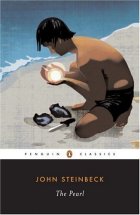
The Pearl by John Steinbeck
Showing posts with label The Pearl by John Steinbeck. Show all posts

Steinbeck, John "The Pearl"

1947


Reviewed by Marianne
from Let's Read


I absolutely love John Steinbeck. Whether it is a large saga or a short story, he manages to describe the characters so well, to let them come alive, to give you the feeling you are there. I have never lived in the United States, I have actually never been to the United States but the way he describes it, it makes me feel like I have. Well, at least during his times. And he also describes the landscape so vividly, it feels almost like looking at a painting only someone is explaining it to you.

The story is a sad tragedy, telling of the problems of the indigenous inhabitants of Mexico, how they have to struggle through their daily lives and yet never can hope to get anywhere. Even when they seem to find a treasure, others manage to ruin it for them. Another story about how the invaders exploited the natives. Apparently an old Mexican folktale, the story rings true to your mind.

This story is a parable, full of symbolism. We have the pearl fisher and his family, we have the evil that threatens them in many forms, we have the richness that is about to come to them but taken away. We have the pearl telling its own story. It changes its music that you can almost hear, it changes its soul the same way as the story takes its path from the beginning to the end. The characters change throughout the book as well as the relationship between the characters develop, an interesting view into the lives of this culture.

A very powerful story, as anything by this fabulous author who received the Nobel Prize for Literature in 1962 "for his realistic and imaginative writings, combining as they do sympathetic humour and keen social perception". Well deserved.

From the back cover:

"In the town they tell the story of the great pearl - how it was found and how it was lost again. They tell of Kino, the fisherman, and of his wife, Juana, and of the baby, Coyotito. And because the story has been told so often, it has taken root in every man's mind."

Find the other John Steinbeck books I read here. 


Read my other reviews of the Nobel Prize winners for Literature.  


Original Post on "Let's Read".

The Pearl by John Steinbeck


Reviewed by: Gillian Valladares Castellino


"The music of the pearl drifted to a whisper then disappeared". 
That is the last line of The Pearl.  As far as 'hooks' go, Steinbeck could not have chosen a better one to reel in a reader who tends to read last lines of books before first ones. A little gem of a book, The Pearl begins with the promise of extolling the virtues of a simple life. It delivers something quite different: an invitation to examine ugliness, beauty, inequality, greed, randomness, basically all the complexities that underpin human lives. All this and more, delivered in under one hundred short pages.

Reviews of The Pearl are quick to point out that the novella is not one of Steinbeck's critically acclaimed works despite the fact that it has been a textbook for American middle and high-schools for many years and is thought to have influenced Hemingway to write The Old Man and the Sea (1952).  The story was first published in 1945, in the Woman's Home Companion, where it was called 'The Pearl of the World.'  It is claimed that some versions are entitled 'The Pearl of La Paz.' Also, a line of thought that suggests that the novella was penned as a result of Steinbeck's interest in the teaching of Carl Jung, specifically the issues of "human greed, materialism and the inherent worth of a thing".

The best introduction to the story is in Steinbeck's own words ...
"as with all retold tales, that are in people's hearts, there are only good and bad things and black and white things and good and evil things and no in-between anywhere.
If this story is a parable, perhaps everyone takes his own meaning from it and reads his own life into it..."
So what is the novella about?  Set around the turn of the last century, in colonial Mexico, specifically in the rural town of La Paz on the Baja Penninsula, it is the story of Kino, a young Mexican-Indian pearl diver, his partner Juana and their baby Coyotito. The plot line of the story is simple, but that is not it's point at all. It's significance and beauty lies in the "telling". 

The story begins as follows: Kino, a simple fisherman, his wife Jauna and son Coyotito live an idyllic existence until the little boy is stung by a scorpion. The town's doctor refuses to even see the child as the parents are poor. Kino in desperation dives for and retrieves a large valuable pearl. "The essence of pearl mixed with essence of men and a curious dark residue was precipitated. Every man suddenly became related to Kino's pearl and Kino's pearl went into the dreams, the speculations, the schemes, the plans, the futures, the wishes, the needs, the lusts, the hungers of everyone, and only one person stood in the way and that was Kino, so that he became curiously every man's enemy.....The poison sacs of the town began to manufacture venom, and the town swelled and puffed with the pressure of it....But Kino and Jauna did not know these things.  Because they were happy and excited they thought that everyone shared their joy.....in the incandescence of the pearl the pictures formed of the things Kino's mind had considered in the past and had given up as impossible."

Without giving too much more away, let it be said that the finding of the pearl becomes a transformative event in the most foul and tragic sense of the term. After the tragedy devastates Kino and Jauna, they throw the pearl back into the depths of the ocean.

Though short in length, The Pearl deals with three major themes - First, the destructive role of greed. Second, the part that fate and human intention/action play in shaping individual lives. Though human beings may focus on and work towards specific goals, fate often intervenes in an apparently random manner and changes everything. The third theme is colonial society's oppression of native cultures. The novella depicts the arrogance, condescension, self-centredness, greed and dismissiveness that colonizers displayed towards the natives. This behaviour has a negative effect on its targets, transforming them from innocent, pious, pure societies into perverted extensions of the colonizer's mentality. Yes, despite the folkloric beauty of its prose, this is a very dark tale.

Recurring motifs in the book are nature imagery and Kino's songs, especially 'The Song of Evil' vs 'The Song of the Family'. These two motifs are used throughout the narrative to progress the plot and develop the themes.

There are also three main symbols used in the story. These are: the pearl (obviously), the scorpion (which precipitates the action) and finally Kino's canoe, which represents native cultural heritage and the spiritual understandings implied within them. Though undervalued in colonial society, for Kino, his canoe underpins who he is, providing both a means of livelihood and a means to find the pearl of great value. It's destruction foreshadows the shattering of his own innocence.

Original post on Healing Scribbles:
http://jillvc-artstuff.blogspot.com.au/2015/10/the-pearl-by-john-steinbeck-and.html

The Pearl by John Steinbeck


First line: Kino awakened in the near dark.

I've been meaning to say a few things about this slim but packed book. This may be required reading in US schools, but here in the Philippines, I've seen more than a few of old browning copies languishing in school libraries.

Which is a pity. Steinbeck has written a beautiful parable of what greed can do to even the kindest, most upright man. It traces how in your quest to find the "solution" and eventually have the "solution" in your grasp, that you slowly realize that you have subconsciously turned into the very type of person you despise.

More importantly, I feel that it brings us back to basics, in a rather dramatic fashion - pointing out the obvious: that money can never take the place of the a happy family and a sense of community.

Two paragraphs sum up the transformation of the pearl and Kino:
" ... there it lay, the great pearl, perfect as the moon. It captured the light and refined it, and gave it back in silver incandescence. In the surface of the great pearl he could see dream forms." (p. 25)
"And the pearl was ugly; it was gray, like a malignant growth" (p. 117)
I read this in a day, but what I got from it is invaluable. Good and evil both reside in men, cliche as it may sound, and what one must do to fight the evil often means learning just how ugly one's soul can be.

It does also raise more questions: Are things sometimes better left alone? Does this mean we shouldn't strive for a better life, and become complacent? How does one deal with temptation, when one is so ill equipped to do so?

Last line: And the music of the pearl drifted to a whisper and disappeared.
[Original post on aloireads.wordpress.com]

The Pearl by John Steinbeck (Wendy)

Kino deftly slipped his knife into the edge of the shell. Through the knife he could feel the muscle tighten hard. He worked the blade lever-wise and the closing muscle parted and the shell fell apart. The lip-like flesh writhed up and then subsided. Kino lifted the flesh, and there it lay, the great pearl, perfect as the moon. it captured the light and refined it and gave it back in silver incandescence. It was as large as a sea-gull's egg. It was the greatest pearl in the world. -From The Pearl, page 26-

Kino, his faithful wife Juana, and their young child Coyotito live in a small fishing village in Mexico. Their simple lives are transformed overnight when Kino finds "The Pearl of the World" in the sea one day.

Steinbeck has written a parable about how wealth may erase innocence and bring evil into our lives. With his lyrical and beautiful prose, he brings the story to life. Juana symbolizes wisdom and common sense - she is Kino's partner and supports his dreams and idealism while being wary of the pearl's lure. Kino's brother is the voice of reason and caution - he represents the history of his people, recognizing that they will always be cheated and must not show too much ambition lest everything that is good will be torn from them. In less than 100 pages, Steinbeck pulls the reader in and makes her care deeply about the characters - we reluctantly turn the pages knowing that only disaster awaits Kino and his family as the pearl becomes Kino's soul and desire. The tale is archetypal as it represents ideas common to all people - greed and desire for wealth. Steinbeck uses the idea of music (the song of family, the song of evil, the song of the pearl) to create a dreamlike story. His attention to detail adds complexity to his character, as when Kino and Juano prepare to go out to sell the pearl.

Kino put on his straw hat and felt it with his hand to see that it was properly placed, not on the back or side of his head, like a rash, unmarried, irresponsible man, and not flat as an elder would wear it, but tilted a little forward to show aggressiveness and seriousness and vigor. There is a great deal to be seen in the tilt of a hat on a man. -From The Pearl, page 49-

The Pearl is felt to be a deeply personal story for Steinbeck who wrote it soon after his overnight success with The Grapes of Wrath. Disillusioned and overwhelmed by the reaction to that novel, Steinbeck turned inward to examine his own motivations. The Pearl also reveals Steinbeck's understanding of people of poverty, including the underlying discrimination he witnessed against the Mexican people in the 1940s.

The Pearl is another masterpiece by this Nobel Laureate.

Highly recommended; rated 5/5.
·
OLDER


© Read the NobelsMaira Gall