2007: Doris Lessing
Showing posts with label 2007: Doris Lessing. Show all posts

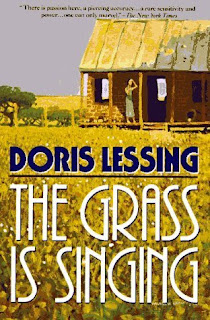
Lessing, Doris "The Grass is Singing"

1950


Reviewed by Marianne

from Let's Read


Doris Lessing's first novel. It received a lot of praise and she was an author of whom much was excepted. She fulfilled it all, her Nobel Prize is a great testimony.

The story takes place in Zimbabwe when it was still called Rhodesia. I guess it could have been any other colony where the white rulers made the black natives their subservients. As we all know, that didn't last forever, it couldn't last forever.

We can see the trouble by looking at some settlers and their problems. Not only did they not know the land and its very own specifics, they were not meant for a climate and a country like this. It had to lead to disaster, one way or another.

Doris Lessing describes the problems very well by looking at Mary, married to a poor farmer, unhappy with her life, not knowing how to improve it. You can tell that she lived in the country herself.

Comments by other members from our book club:
We had a really good discussion about this book and it was scored 4/5 or 5/5 by all.
The writing was excellent in making one see and feel the location and climate. We discussed many topics: the main characters, their psychology and motivations, the time and history and societal pressure for marriage and being the "right kind of white" and pressure to conform to the status quo. Gender roles. Mental health. The different ways of farming the land in the story. The slow gradual changes from outright slavery but not yet really an equal society. And obviously the obsessive and very inappropriate thoughts and behaviour that led to the gruesome end.
I probably forget a lot of aspects, but very interesting.
I again feel older and wiser for having read this book. I might even add some other of her works to my TBR pile.

Book Description:

"Set in South Africa under white rule, Doris Lessing's first novel is both a riveting chronicle of human disintegration and a beautifully understated social critique. Mary Turner is a self-confident, independent young woman who becomes the depressed, frustrated wife of an ineffectual, unsuccessful farmer. Little by little the ennui of years on the farm work their slow poison, and Mary's despair progresses until the fateful arrival of an enigmatic and virile black servant, Moses. Locked in anguish, Mary and Moses - master and slave - are trapped in a web of mounting attraction and repulsion. Their psychic tension explodes in an electrifying scene that ends this disturbing tale of racial strife in colonial South Africa.

'The Grass Is Singing' blends Lessing's imaginative vision with her own vividly remembered early childhood to recreate the quiet horror of a woman's struggle against a ruthless fate."

Doris Lessing "that epicist of the female experience, who with scepticism, fire and visionary power has subjected a divided civilisation to scrutinyreceived the Nobel Prize for Literature in 2007.

Read my other reviews of the Nobel Prize winners for Literature.

Original Post on Let's Read.

The Golden Notebook by Doris Lessing

1962


Reviewed by Marianne
from Let's Read


It has been ages since I read "The Golden Notebook", probably shortly after it was published. It is one of those books that I still remember after many many years. I thought it was very good and very sensitive, approached the subject of women's liberation in a very unique but helpful way.

When we discussed this in our book club, most members did not really like the book very much. A few of us "older" members had the feeling that the younger readers couldn't really follow the reasons this book was written for, they had not lived during the time where a girl "did not need an education because she would get married anyway". Ladies like Doris Lessing and her characters are responsible that the situation isn't as bad any more, at least not in our part of the world.

From the back cover:

"Anna is a writer, author of one very successful novel, who now keeps four notebooks. In one, with a black cover, she reviews the African experience of her earlier year. In a red one she records her political life, her disillusionment with communism. In a yellow one she writes a novel in which the heroine reviles part of her own experience. And in the blue one she keeps a personal diary. Finally, in love with an American writer and threatened with insanity, Anna tries to bring the threads of all four books together in a golden notebook.

Doris Lessing's best-known and most influential novel,
The Golden Notebook retains its extraordinary power and relevance decades after its initial publication."

Doris Lessing "that epicist of the female experience, who with scepticism, fire and visionary power has subjected a divided civilisation to scrutiny" received the Nobel Prize for Literature in 2007.

Read my other reviews of the Nobel Prize winners for Literature.

Original Post on "Let's Read"

The Good Terrorist by Doris Lessing

Reviewed by Edith LaGraziana

In the European Union we are living an era of relative peace and security which makes us easily forget that ever again in human history conservative as well as revolutionary powers (be they stately, religious or ideological) tried to eradicate “dangerous” ideas and ways of life by force and with childish obstinacy. Irony of fate has it that they all disappeared sooner or later leaving little more than ugly spots on collective memory and consciousness. Nonetheless also those who believe terror a proper means of politics are human beings and The Good Terrorist by Doris Lessing, which I’m reviewing today, shows what might go on in the mind of one who wants to force the perfect world of her own dreams on society because others don’t seem to have the courage to fight for it.

Doris Lessing was born Doris May Taylor in Kermanshah, Persia (today: Iran), in October 1919. In 1925 the family moved to a farm in Southern Rhodesia (today: Zimbabwe) where she attended a convent school until she started working as a nursemaid at the age of fifteen. Encouraged to continue studying on her own by her employer she soon turned to writing and her first stories were published in magazines. Her true career as a writer, however, started only after two failed marriages and having moved to London, U.K., in 1949. She brought out her first novel The Grass is Singing in 1950, but her literary breakthrough didn’t come before 1962 when The Golden Notebook appeared. For her life-work consisting of more than two dozen novels – like for instance Briefing for a Descent into Hell (1971), Memoirs of a Survivor (1974), The Good Terrorist (1985), The Cleft (2007), and the two series known as The Children of Violence (1952-1969) and The Canopus in Argos (1979-1983) –, almost as many short story collections, some autobiographical texts, essays, plays, and poems the author was rewarded with the Nobel Prize in Literature 2007. Doris Lessing died in London, U.K., in November 2013.

It’s in the early 1980s and The Good Terrorist starts as a rather ordinary Communist squatter who joins a commune of comrades already living in a derelict house in London. Her name is Alice and she is a woman of thirty-six with a degree in Politics and Economics, but to her parents’ great annoyance she never even tried to get a job after graduation. For over fifteen years she has been moving from squat to squat with her likewise jobless friend Jasper in tow although they aren’t really a couple. Alice loves Jasper, he only depends on her, though, and can’t even bear her touch because he is homosexual and loathes women. When Alice and Jasper arrive at the spacious house in 43 Old Mill Road, it is little more than a smelling rubbish heap that serves as a temporary shelter. Only Alice sees in it a beautiful place that she can turn into a comfortable home. So while the others go to demonstrations and pickets, Alice does everything in her power to save the house from impending demolition and to restore it to some of its former splendour which requires not only a lot of cunning on her side, but also much more money than she gets from Social Security. Since friends and parents refuse to help out – knowing that most of the money would inevitably end in the hands of Jasper –, she resorts to stealing it from her father against whom she has a grudge. Politically Alice and her comrades of the Communist Centre Union want to increase their political impact and offer their services first to the IRA and then to the KGB. Neither wants them. They attract, however, the attention of the squatters from the neighbouring house and before soon they are really involved in activities of IRA and KGB... but they are annoyed because they are no longer willing to take orders. They set out to fight against fascist imperialism all on their own building a car bomb…

At the time of its release The Good Terrorist has been a highly controversial novel. The plot of the third-person narrative from the protagonist's point of view is simple and doesn’t offer many ups and downs because it is centred on daily life in the commune or rather on Alice’s constant struggle to keep it going. Alice is an ambiguous character largely driven by rage against her parents and society which she equals with fascist imperialism without really thinking about it. She refuses their middle-class values, and yet, she lives them when she adopts the role of a mother who spares neither pains nor expenses to take care of her house and her family, i.e. the squatters. In other respects her behaviour often makes think of a “sweet girl” in her adolescence. This becomes most obvious in her relationship to Jasper that doesn’t force her to grow up emotionally and sexually for the simple reason that he is homosexual, while adult desires and practices scare and disgust her as show the scenes in comrade Andrew’s room. At the same time it is obvious that she is also a spoilt child who believes that her parents and the world should be the way she wants them to be. Altogether Alice may seem depicted in a rather superficial way, but then she isn’t a particularly deep person – nor are the other squatters. Doris Lessing’s language and style match the atmosphere in the commune which certainly can’t be called warm and intellectual. Words flow in a matter-of-fact tone and make the story easy to follow.

At first I wasn’t quite sure if I should review The Good Terrorist by Doris Lessing because it might evoke unpleasant memories of recent terrorist attacks in Paris, Copenhagen and now Tunis. On the other hand, I think that it’s a good idea to slip into the skin of a terrorist for as long as it takes to read the novel. There may be much truth in what the author had to say about her group of terrorists, but it’s the work of a fiction writer, not of a psychologist or a profiler. And the novel's terrorists live in the 1980s, thus in a pre-digital age. However, it’s an excellent book and therefore worth reading.

In memoriam of the innocent victims of the terrorist attacks in Paris (January), Copenhagen (February) and Tunis (March) 2015.

Original post on Edith's Miscellany:

Ben, In the World by Doris Lessing

Reviewed by Sandra at Fresh Ink Books.

Fiction, 178 pages Hardcover

UK ( 2002)

Ben, In the World by Doris Lessing is the sequel to The Fifth Child which I reviewed in the post below this one. That book gave us Ben, born into a large family who welcomed each child with celebration. Unlovable and uncontrollable from birth, freakish in appearance, he confuses and frightens everyone around him. He is violent and seems incapable of learning. In the end, though she defends him from others, even his mother cannot love him or even stand to have him around. Ben, In the World begins after he has divided and alienated most of his family and left home in his teens.

What becomes of such an angry young monster, lacking control in all matters, uncomprehending the world and people in general, prone to violence and inviting rebuke by his physically threatening appearance? There is always someone who will be a little kind with food or money to a homeless young man, though most will not. Then there are the unscrupulous who will use people like Ben for criminal activities, knowing he doesn't understand what he's doing and is incapable of communicating information about them to authorities if he's caught. Woman are sometimes kind, even tolerant to a point. But he knows they are always afraid of him. He struggles constantly against his own instincts to hurt people when he perceives mockery or even a slight. The only thing that holds him back is nightmarish memories of being institutionalized and the fear that he will be taken back there. He suffers a strong sexual drive that can only lead to trouble.

Abandoned in another country by criminals who have no further use of him, Ben is eventually spotted by a film maker who thinks of him as a caveman throwback and takes care of him while he has an interest in making a film with him. He will end up on another continent, driven by a spurious promise to find his own "kind", where he will finally come to face the reality of what he really is. Well written and brutally honest in the end, Lessing is brave enough to show us what everyone secretly thinks about people like Ben. They are unwanted, and there is no sadder fate for anyone.
I recommend it, but read
The Fifth Child first. It's worth it.

The Fifth Child by Doris Lessing

Reviewed by Sandra at Fresh Ink Books

Fiction,133 pages Hardcover


1988 UK

The idea of a mother not loving her own child seems almost taboo as a subject for a novel. Such feelings just aren't possible, or at least they're not natural or normal, are they? That's the general consensus. I wanted to read The Fifth Child because someone said it put them in mind of Lionel Shriver's We Need to Talk About Kevin, which I reviewed and recommended highly. They are both about having a child who is difficult to love. Let's be honest, even their mothers find them impossible to love. They do try, very hard, over a period of long years, but ultimately admit their true feelings.

Both books are well written and I thought at first they were quite different stories. Kevin, in Shriver's book is a teenager who's killed fellow students in a school shooting before the story even begins. Ben, the fifth child to a couple who planned a large family and celebrated each child's arrival, is odd and frightening and difficult to control from the day he's born. We follow his beleaguered mother and family from birth through to his teen years.

Then I realized that the only difference in the stories is whether they are related to us before disaster strikes, as in the case of Ben, or afterward, as with Kevin's killing spree. Each book hits tender spots and like most tragedies are not the easiest to read. But I think they both need to be read. The questions raised need to be faced-by everyone. Should these children be drugged? Is psychiatry or behaviour therapy enough? Should they be "put away" in cases where they cannot be controlled? Then there's the issue of blame. People seem to need to point fingers when things go wrong. Are the parents, especially the mothers, ultimately responsible for the monstrous behaviour of their children?

I'm glad I read these books. I learned things, empathy being the very least of these. I recommended The Fifth Child.

I have now read and reviewed its sequel Ben, In the World by Doris Lessing.

Eldorado by Doris Lessing

Author: Doris Lessing
Genre: psychological
Published: 1962
Personal rating: 5/5


This short novel, some would call it a novella, packs quite a punch. It's the first book by Doris Lessing I've ever read, and I immediately see why she's a Nobel Prize winner. Her prose is beautiful. It's simple and complex at the same time.

The whole book revolves around a family of three and the relationships between them. Those relationships get very tense when the father of the family gets obsessed with finding gold. For a very long time, I thought I knew what the twist at the end would be. Boy, was I wrong. But good wrong, as I think Doris Lessing's ending is far more beautiful, fitting, and life-like than my imagined ending would have been.

If you want to read a Nobel Prize winner, or a book by Doris Lessing, pick this one. It's great. I can't wait to read more of Doris Lessing. This one is very much recommended.


Did you review this book? Please leave a link in the comments and I will add it to my post.

This review was cross-posted on my own blog: Bookworms and tea lovers. Please stop by for a visit.

The Good Terrorist by Doris Lessing

(Cross-posted from my blog, Out of the Blue)

My next book for this challenge is The Good Terrorist by Doris Lessing. The book was shortlisted for the Booker Prize in 1985.

The Good Terrorist follows Alice Mellings, a woman who transforms an abandoned home into headquarters for a group of radicals who plan to join the IRA. As Alice struggles to keep the group together, her companions find unexpected difficulties in their quest to bring forth social change against complacency and capitalism.

This book was a very interesting read, an insight into the life of politically involved squatters in 1980s London. The main character, Alice, is a woman in her mid thirties who does everything she can to create a home out of an abandoned house. Her efforts go largely unappreciated by her companions, who are more interested in connecting with more important subversive groups, such as IRA. Thus Alice, the "good" terrorist of the title, finds herself cooperating in realterrorist activities.

In her book, Doris Lessing portrays a woman with strenght and determination, but without something to really fill her life. She likes to take care, take charge, be practical; she's always there, always reliable, running the house while the others are busy picketing the streets. Around her, the author depicts a full set of personalities and what makes them drawn to terrorism.

A very interesting, vivid book; one I'd recommend to anyone interested in this topic.

On Not Winning the Nobel: Doris Lessing's Nobel Lecture


Theindividualvoice pointed out the importance of Doris Lessing's Nobel Lecture which tackled the "importance of literacy to be able to write, and that so many in this world with stories to tell are not afforded that chance at literacy and are hungry not only for food but for books." She has posted the full text in entirely accompanied by some relevant photos on her blog.

Thanks for pointing out its powerful message. Everyone should read (or listen) to it in full.

You can get the official transcript here.
For the official video and other translations, click here.

Just a few reactions to the speech here, here, here ("inanities of the internet")

An interview about Doris Lessing


More video interviews of laureates here.

Doris Lessing: Five Selections

“Oh, Christ!” Doris Lessing is reported to have said when told she’d won the 2007 Nobel Prize for Literature. The 87-year-old author has been a favourite for the Nobel for at least three decades now — her collected works would fill an entire bookshelf, and she is still widely read and discussed. Her oeuvre is so vast that it’s hard to capture the full impact of her writing, but here’s a look at some of her work.

The Grass is Singing: (1950)
The Golden Notebook: (1962)
Children of Violence: (1952-1969)
Canopus in Argos: (1979-1983)
The Diaries of Jane Somers: 1984

Read the full article by Nilanjana S Roy in the Business Standard here.

Doris Lessing: 2007 Laureate

And the announcement is in! Doris Lessing is the 2007 Nobel Laureate for Literature: "that epicist of the female experience, who with scepticism, fire and visionary power has subjected a divided civilisation to scrutiny."

More on Doris Lessing:
·
OLDER


© Read the NobelsMaira Gall