Siddhartha by Hermann Hesse
Showing posts with label Siddhartha by Hermann Hesse. Show all posts

Siddhartha by Hermann Hesse


(German Title: Siddhartha) - 1922

Reviewed by Marianne from "Let's Read"

This is by far my most favourite Hesse story. Maybe because it is so much more positive than his other books, despite the subject. But I don't think that is it. I think he has given this book a lot of thought and describes the voyage any young person has to make all over the world, not necessarily the same way as our protagonist Siddartha but we all have to find our goal, our meaning of life, our meaning in life.

In ancient India, Siddhartha, the son of a Brahmin, the highest caste, becomes an ascetic. Together with a friend he wants to find the enlightenment. We accompany him on his quest.

The story might be set in ancient times and in a country quite far from Hesse’s native Germany but it could have been anywhere and at any time. The author himself actually lived like his character, searched for the meaning of life in Hindu and Buddhist scriptures.

This philosophical novel has a very lyrical writing style. I really enjoyed reading it. (i.e. the German original.)

It would be great if everyone read this book at least once in their life, the earlier the better. And I am sure everyone will enjoy it, no matter whether they belong to a religion, any religion, or not, whether they believe in a higher being or not. Because this is not a book about Buddha, God or religion, it is a novel about our soul.

Two quotes from Siddhartha:
“Wisdom is not communicable. The wisdom which a wise man tries to communicate always sounds foolish... Knowledge can be communicated, but not wisdom. One can find it, live it, do wonders through it, but one cannot communicate and teach it.”

“When someone is seeking ... it happens quite easily that he only sees the thing that he is seeking; that he is unable to find anything, unable to absorb anything ... because he is obsessed with his goal. Seeking means: to have a goal; but finding means: to be free, to be receptive, to have no goal.”

Need I say more?

Book Description: "Siddhartha is perhaps the most important and compelling moral allegory our troubled century has produced. Integrating Eastern and Western spiritual traditions with psychoanalysis and philosophy, this strangely simple tale, written with a deep and moving empathy for humanity, has touched the lives of millions since its original publication in 1922. Set in India, Siddhartha is the story of a young Brahmin's search for ultimate reality after meeting with the Buddha. His quest takes him from a life of decadence to asceticism, from the illusory joys of sensual love with a beautiful courtesan, and of wealth and fame, to the painful struggles with his son and the ultimate wisdom of renunciation."

I also read “Steppenwolf” by the same author.

Hermann Hesse received the Nobel Prize for Literature in 1964 "for his inspired writings which, while growing in boldness and penetration, exemplify the classical humanitarian ideals and high qualities of style".

Read my other reviews of the Nobel Prize winners for Literature.
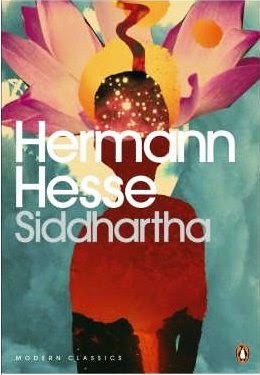
Siddhartha by Hermann Hesse

http://www.amazon.co.uk/gp/product/0141189576/ref=as_li_qf_sp_asin_tl?ie=UTF8&camp=1634&creative=6738&creativeASIN=0141189576&linkCode=as2&tag=editsmisc00-21Reviewed by Edith LaGraziana

In a noisy and glaring world like ours it can be very difficult to discover the right way through life. There is so much to distract us from what is really important, including our vocation. Those who are lucky find the right bend soon, others take longer, and some keep searching until the end. Books can give us a little bit of guidance or at least consolation. I decided to review one of them today and picked Siddhartha by Hermann Hesse. 

Hermann Hesse was born in Calw in the Black Forest, Germany, in July 1877. The son of Christian missionaries in India was sent to boarding school in Germany, but couldn’t adapt to the strict discipline and left before graduation. In addition, he suffered from bipolar depression already from a young age. Hermann Hesse wrote many poems and novels like Peter Carmenzind (1904), Demian (1919), Siddhartha (1922), Steppenwolf (Der Steppenwolf - 1927), Narcissus and Goldmund (Narziß und Goldmund - 1930) and The Glass Bead Game (Das Glasperlenspiel - 1943). In 1946 Hermann Hesse was awarded the Nobel Prize for Literature and his writings keep being much liked by readers worldwide until today. Hermann Hesse died in Montagnola, Switzerland, in August 1962. 

The novel Siddhartha was published in German already in 1922, but the first English translation didn’t come out before 1951. The story is set in ancient India at the time when Buddha found enlightenment under the Bodhi tree and made his teachings. In fact, the novel’s title as well as its plot remind of the life of Buddha who was born as Siddhartha Gautama, Prince of Kapilvastu. Also Hermann Hesse’s protagonist Siddhartha starts into life as a privileged child although not of an Indian king, but of a Brahmin. Growing older he finds his life empty of meaning and leaves home to seek enlightenment. In his quest Siddhartha is accompanied by his childhood friend Govinda who idolizes him. During their travels as wandering and begging ascetics they meet the Buddha – called Gotama in the novel – and listen to his teachings. Govinda decides to follow the way of the Buddha as a monk, but Siddhartha doesn’t get from him the answers that he is looking for. He continues his quest and falls in love with the beautiful courtesan Kamala. In order to please her, Siddhartha gives up his life as an ascetic and becomes a successful businessman. But neither his life with Kamala nor all the luxury that he revels in can satisfy him in the long run. Eventually, he gets restless again and leaves his comfortable home. Siddhartha is tired of life and longs for death. When he meets the ferryman Vasudeva who seems fully at peace with himself, he decides to stay with him and to learn the trade of a ferryman. Siddhartha also learns to listen to the river and its infinite wisdom, but life has yet another important lesson in store for him. 

The story of Siddhartha is told in Hermann Hesse’s usual poetic language that, after ninety years, feels a bit antiquated compared to modern German, but it doesn’t impair the beauty of the text and even less its message. The whole novel tells of the writer’s profound knowledge of Buddhism and Hinduism. The Four Noble Truths as well as the Eightfold Path can be found along the way, but also the three stages of Hindu life – student, householder, and recluse – are there giving the story a natural frame and grip. 

Life is a constant quest of understanding reality. We all know it and Hermann Hesse elegantly put this universal knowledge into a story around the Buddha without writing his fictionalized biography. I enjoy Siddhartha very much every time I read the novel. I always find a new aspect of life in it that had escaped me so far. It’s a book that shows how important it is to go on. Siddhartha by Hermann Hesse is a highly recommendable book for everyone with an antenna for the spiritual.

Original post on Edith's Miscellany:
http://edith-lagraziana.blogspot.com/2013/04/siddhartha-by-hermann-hesse.html

Siddhartha by Herman Hesse

I've been reading several books by Nobel Prize winners lately. Siddhartha was one of them. I can't say that it did anything for me.

Siddhartha is the hero of this allegorical tale of an Indian man's development, from Brahmin student, to mystic, to successful business man and pleasure seeker, to wise ferryboat tender. Maybe back in 1922 when it was first published, or even in the 1960s and '70s when American hippies took it to heart, the examination of Indian mysticism and Buddhism would have been fascinating. But now, when Indian culture is more familiar, it just seems pretentious and overwrought.

Many people love it. It just is not my cup of tea.

Siddhartha by Hermann Hesse (gautami)

Cross posted from: My Own Little Reading Room

Title: Siddhartha

Author: Hermann Hesse
ISBN: 8187981830
Publisher: Indialog/2005
Pages: 167
rating: 4/5


Hermann Hesse wrote it in 1923, and it still is continues to be good read for those who are searching themselves. It is an allegorical story filled with both Eastern and Western philosophy. Siddhartha, a brahmin boy leaves home along with his friend Govinda to fill the thirst in his mind. He goes to leave with the samanas, wandering ascetics, begging for food and spending his days in meditation. Even that does not help him attaining what he truly seeks. Liberation from everything. Nirvana. Then he meets Gotama. This meeting with the Buddha has an unexpected effect on him. He realizes that teachers cannot teach him what he is seeking and that is upto him find his own way to salvation.

Siddhartha's life is shown to be a parallel of Gotama, the Buddha's life. Awakening of the mind and ultimate knowledge is what they both seek. Gotama had done it much before him and Siddhartha has to embark on it all by himself. Siddhartha’s life is interesting as he does not take the easy route. Moving through myriads of experiences he finally attains enlightenment.

Govinda is a shadow of Siddhartha in the beginning but comes out on his own. This too teaches us that it is on us to seek, find and know. In the quest of peace and truth, each of us is alone. We all have to make that journey all by ourselves. No amount of teaching will do it for us.

This is a fairly easy book to read and understand. The philosophy is explained in a simplistic manner. This book has survived eigth decades...And no, this is not a story about Gautama Buddha. It is the story about Siddhartha. Well, I felt better after reading it.
·
OLDER


© Read the NobelsMaira Gall